


How to Make Passive Income with Digital Products: The 2025 Blueprint
I still remember the specific notification sound my phone made the first time I earned money while sleeping. It wasn’t a lottery win, and it wasn’t an inheritance. It was a $19 sale of a PDF guide I had written three months prior. I was eating breakfast, and my bank account grew without me lifting a finger in that moment.
That feeling changes your brain chemistry. It shifts your perspective from “trading time for money” to “building assets that work for you.”
However, let’s be real for a second. The term “passive income” is often hijacked by get-rich-quick schemers. In my experience, true passive income isn’t about doing nothing; it’s about doing the work once (front-loading the effort) and getting paid for it repeatedly. It’s a shift from being a laborer to being an architect.
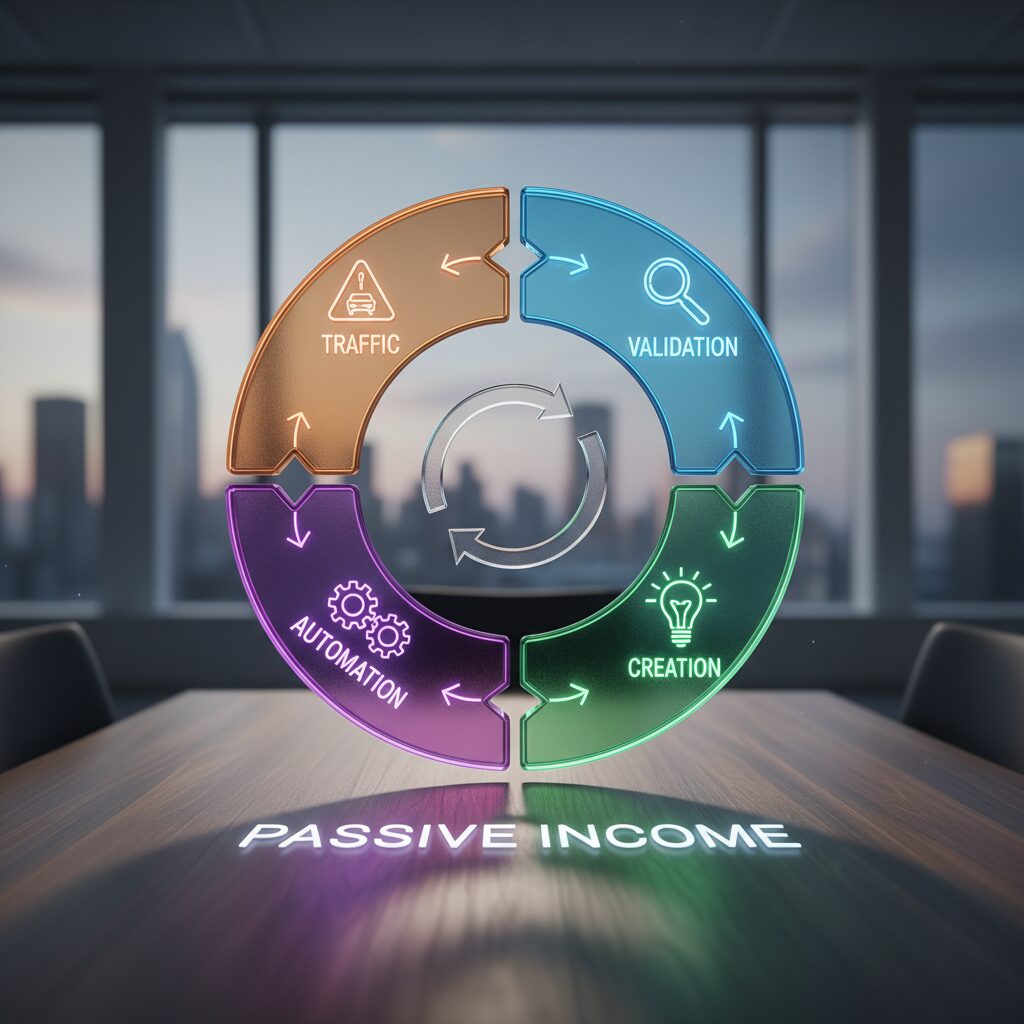
If you are looking for a list of 100 generic ideas, this isn’t it. This is a comprehensive, researched-backed Flywheel System designed to help you validate, build, launch, and automate a digital product business in the 2025 landscape.
Why Digital Products Are the Ultimate Passive Asset (2025 Data)
You might be wondering, “Is it too late to start?” or “Isn’t the market saturated?” The data suggests we are actually just getting started.
According to a 2025 report from Goldman Sachs and Uscreen, the creator economy was valued at $250 billion in 2024 and is projected to double to $500 billion by 2027. That is massive, sustained growth.
The beauty of digital products lies in the economic concept of “Zero Marginal Cost.” If you sell hand-made candles, selling 1,000 units means making 1,000 candles. If you sell a digital course or template, selling 1,000 units costs you exactly the same as selling one (excluding minor transaction fees).
While 70% of creator revenue historically came from brand deals, digital products now offer 70%+ profit margins compared to physical goods, according to data from Burst Commerce.
Furthermore, Whop’s 2025 market report estimates the broader digital goods market will create more than $2.5 trillion in annual value. The appetite for digital learning and tools is insatiable. In fact, Teachable’s research indicates that 95% of consumers say they have learned something new from a creator, with 62% trusting creators with educational content more than traditional entertainment sources.
Step 1: Niche Discovery & Product Validation
The biggest mistake I see beginners make is starting with the product rather than the problem. They spend months writing an ebook on “How to Be Happy,” launch it to crickets, and then claim the business model doesn’t work.
You must move beyond “follow your passion.” Instead, follow the pain. People pay to have problems solved.
Finding “Blue Ocean” Niches in 2025
General niches are crowded. You don’t want to sell “Fitness Advice.” You want to sell “Post-Partum Core Rebuilding Exercises for C-Section Moms.”
As Neil Patel famously stated regarding market saturation: “Mediocre marketers think in terms of campaigns. Great marketers think in terms of growth frameworks. The market is crowded, but specific problem-solving never saturates.”
In 2025, successful niches are hyper-specific. Here are a few I’ve seen gaining traction:
- Notion Dashboards for Neurodivergent Brains: Helping people with ADHD organize their lives.
- AI Prompts for Specific Professions: E.g., “Midjourney Prompts for Interior Designers.”
- specialized Excel Templates: E.g., Estimating spreadsheets for construction contractors.
The Keyword Validation Technique
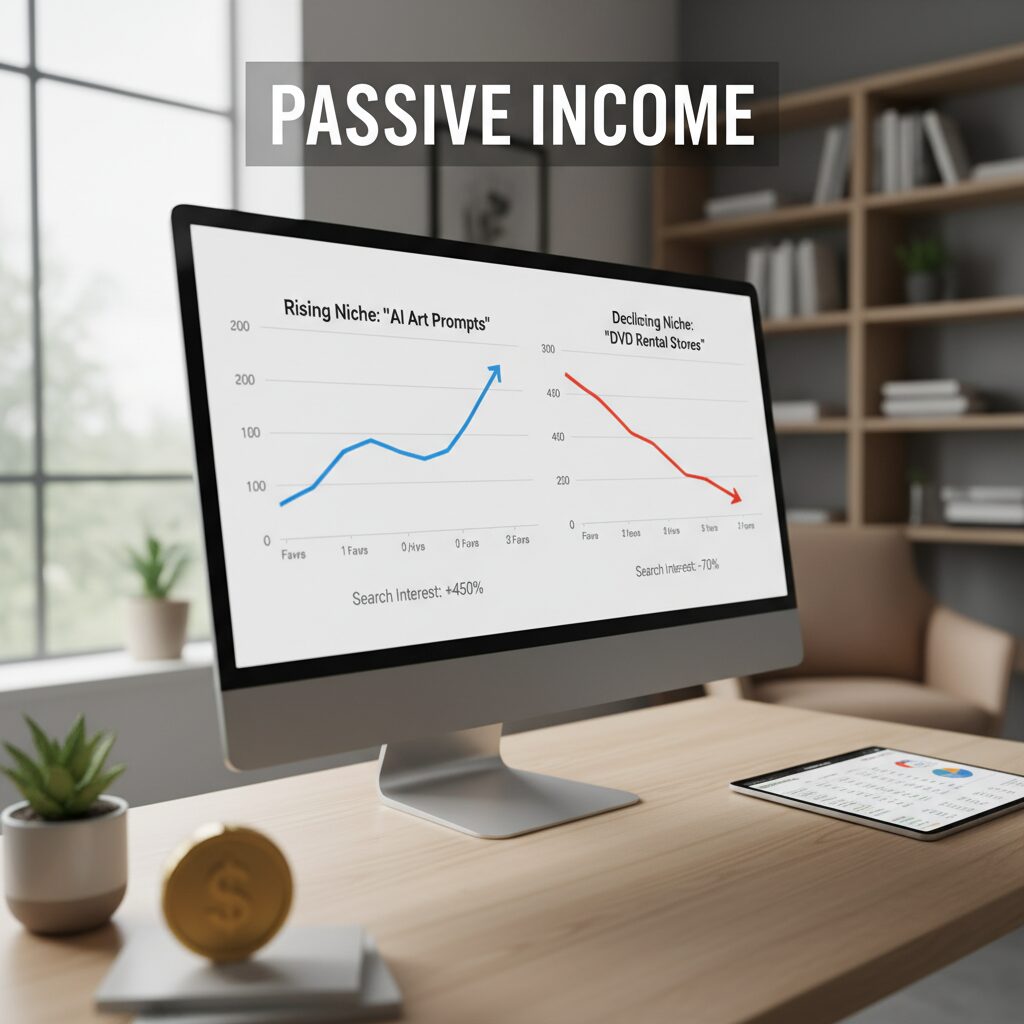
Before you create anything, validate it. Go to Etsy or Amazon KDP and search for your idea. If there are products with sales, that’s a good sign—it means there is a market.
Then, use Google Trends. If the trend line is flat or rising, proceed. If it’s declining, pivot. You are looking for proof of concept before you invest your time.
Step 2: Creating High-Value Digital Assets
Once you have a validated problem, you need a vehicle to solve it. The format you choose dictates your pricing and your time investment.
The “Low-Hanging Fruit”: Templates and Printables
This is the easiest entry point. These are low-ticket items ($5 – $30) that rely on volume. Think budget planners, Lightroom presets, or resume templates.
Case Study: The Volume Strategy
Erin Confortini, a finance creator, focused on selling budget templates via TikTok. Despite the low price point ($5-$10), she generated $138,262 in 2024. Her success proves that you don’t need a $1,000 course to make six figures; you need a high-converting funnel for a low-friction product.
Source: YouTube Income Report (Jan 2025)
The Authority Builders: Ebooks and Courses
If you have specialized knowledge, this is where the margins explode. Forbes reported in May 2024 that creators on Teachable and its parent platforms have earned over $10 billion in lifetime GMV.
Using AI Ethically to Accelerate Creation
I was initially skeptical about AI in creative work, but the productivity gains are undeniable. You can use tools like ChatGPT to outline your course modules or write Excel formulas for your templates. You can use Midjourney to create cover art.
However, the content must be yours. AI is a tool for structure, not a replacement for expertise. Your unique voice and experience are what people pay for.
Step 3: Setting Up Your “Storefront”
Where should you sell? This is a common stumbling block. Generally, you have two choices: Rented Land (Marketplaces) or Owned Land (Your own site).
The Marketplace Route: Etsy & Amazon KDP
Pros: They bring the traffic to you.
Cons: They take a cut (fees), and you don’t own the customer email list.
Case Study: The Etsy Success
A creator operating under “InsightsByJess” opened an Etsy shop selling complex spreadsheets. By leveraging Etsy’s internal search traffic, she earned $168,000 in her first year (2024) with zero initial ad spend. This highlights the power of high-perceived value (complex spreadsheets) over simple printables.
Source: InsightsByJess Case Study (2025)
The “Link-in-Bio” Revolution: Stan Store & Gumroad
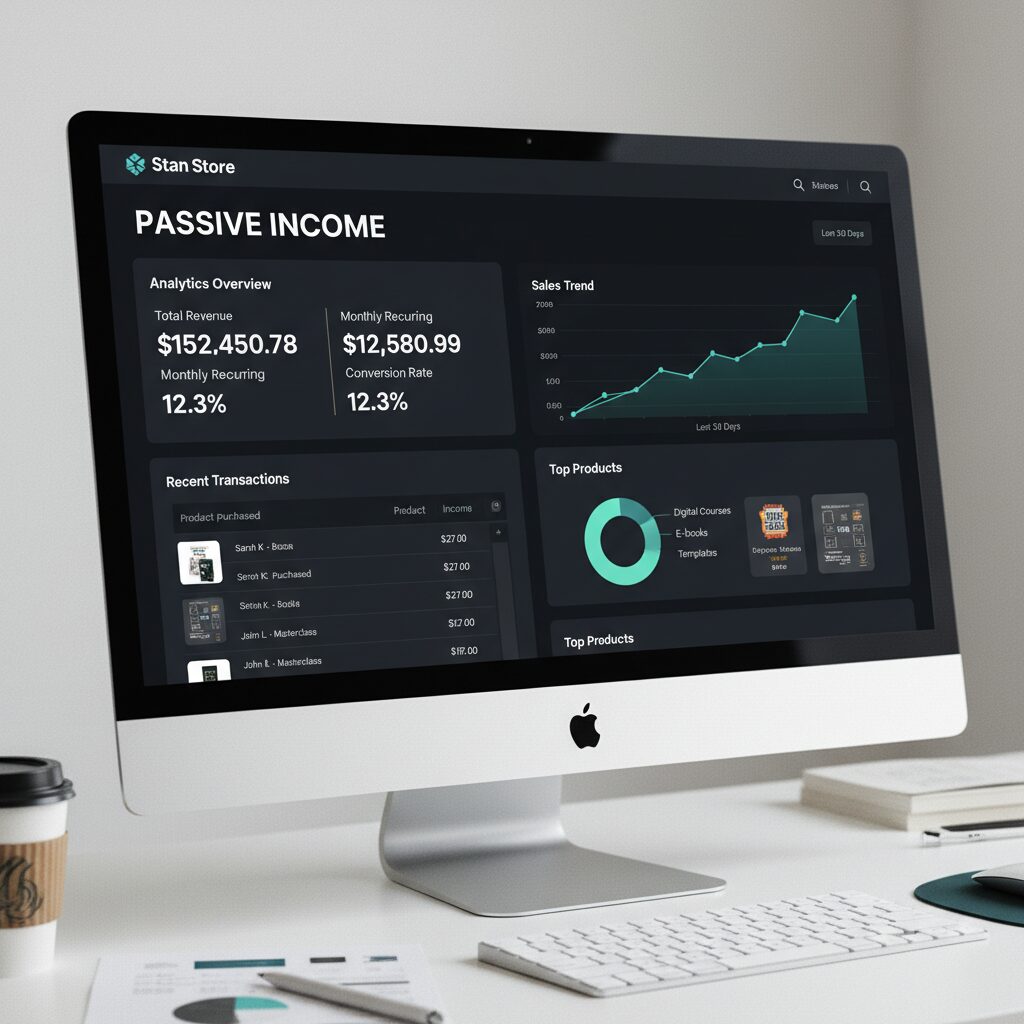
For most creators in 2025, platforms like Stan Store or Gumroad are the gold standard. They are optimized for mobile and integrate seamlessly with social media.
Gumroad is fantastic for beginners because there is no monthly fee, though they take a higher transaction cut (10%). Stan Store charges a flat monthly fee but takes 0% transaction fees, making it better for volume sellers.
Step 4: Building the “Passive” Funnel (Automation)
This is the section that turns an “active side hustle” into “passive income.” If you are manually emailing files to customers, you have created a job, not a business.
You need an automated delivery system. Here is the architecture I recommend:
- Traffic Source (Social Media/SEO)
- Lead Magnet (Free value in exchange for email)
- Tripwire Offer (Low-cost product offered immediately)
- Core Offer (The main product)
The Tripwire Strategy
A “Tripwire” is a product priced between $7 and $27 that is offered immediately after someone signs up for your free lead magnet. The goal isn’t profit; it’s to turn a subscriber into a customer psychologically.
Even if you break even on ads with your tripwire, you have acquired a customer for free. Burst Commerce analysis highlights that email marketing delivers an ROI of $36 to $42 for every $1 spent. Once they are on your list, you can sell your higher-ticket items on autopilot via an email sequence.
Digital Product Profit Potential Calculator
Estimate your monthly passive income based on traffic and conversion rates.
Estimated Revenue: $0 / month
Step 5: Traffic Sources That Don’t Require 24/7 Posting
Passive income requires momentum. You can’t just build it and expect them to come. However, you also don’t want to be a slave to the Instagram algorithm.
SEO: The Long Game
Blogging remains one of the best sources of passive traffic. An article you write today about “Best Lightroom Presets for Wedding Photographers” can drive traffic for years. This is “evergreen” traffic.
Pinterest: The Visual Search Engine
Do not treat Pinterest like social media; treat it like Google with pictures. It is incredibly effective for digital goods. Create “pins” that lead directly to your lead magnet landing page.
Flash Sales for Cash Injections
Even with a passive setup, occasional active promotions work wonders. A creator known as “The Marketing Bully” utilized a flash sale strategy, dropping old digital tools to $5. She sold 500+ products in 72 hours. This proves that discounting older inventory can generate massive cash injections without creating new products.
Source: YouTube Case Study (July 2024)
Common Hurdles & FAQ
Is selling digital products oversaturated?
Broad niches are saturated, but micro-niches are not. As G2 Learning Hub reports, 68.2% of Gen Z is earning through digital side hustles. The competition is there, but quality stands out. If you solve a specific pain point better than others, you will win.
Do I need a business license?
In most jurisdictions, yes. Even if you are a sole proprietor, you are operating a business. However, platforms like Gumroad act as the “Merchant of Record,” which simplifies sales tax (VAT) collection for international customers. Always consult a local tax professional.
What if I’m not an expert?
You don’t need to be a guru; you just need to be one chapter ahead of your audience. Alternatively, you can be a “Curator.” A well-organized database of resources is a valuable digital product in itself.
Conclusion
Building a passive income stream with digital products is not about getting rich overnight. It is about front-loading your effort to decouple your time from your earnings. It requires validation, strategic creation, and automated delivery.
The market data from 2024 and 2025 is clear: the creator economy is doubling, and the trust in digital education is at an all-time high. The tools are cheaper and easier to use than ever before.
My advice? Start small. Create a “Minimum Viable Product” (MVP)—maybe a simple checklist or a basic template. Put it out there. Get your first dollar. Once you break the seal of making money while you sleep, you’ll never look at income the same way again.
