


Real Estate Passive Income: How to Start the “Easy” Way in 2025 (Step-by-Step)
Did you know that in 2025, leasing a home is approximately $1,000 per month cheaper than buying a comparable one in major U.S. markets? This financial gap, highlighted by Invitation Homes CEO Dallas Tanner, has fundamentally shifted the American housing landscape.
We are witnessing the rise of a “rentership society.” While this is frustrating for aspiring homeowners, it has inadvertently created the easiest passive income opportunity of the decade for investors—without you ever needing to fix a toilet or chase a tenant for rent.
If you’ve been sitting on the sidelines because you don’t have $50,000 for a down payment or the time to manage a renovation, I have good news: the “easy” way isn’t just a marketing slogan; it’s a data-backed strategy used by the world’s largest investment firms.
Why 2025 is the Year of the “Passive” Investor
Before we dive into the how, you need to understand the why. In my experience watching market cycles, the best opportunities often come when the general public is looking the other way.
The “Rentership Society” and 97.5% Occupancy
The barrier to homeownership has never been higher. According to the National Association of Realtors (NAR) 2024 Profile of Home Buyers and Sellers, first-time buyers made up only 24% of the market—a historic low. Furthermore, 26% of buyers paid entirely in cash, leaving average earners unable to compete.
What does this mean for you? It means the demand for high-quality rental housing is skyrocketing. Major residential landlords like Invitation Homes reported 97.5% occupancy rates entering 2025. People need a place to live, and if they can’t buy, they rent. As a passive investor, you can profit from this rental demand without owning the physical deed.
High Rates Favor the “Passive” Approach
Active landlords are hurting right now. With interest rates remaining elevated, the math for buying a rental property with a mortgage is difficult. However, this environment favors passive vehicles like REITs and private funds, which often have lower leverage or fixed-rate debt locked in years ago.
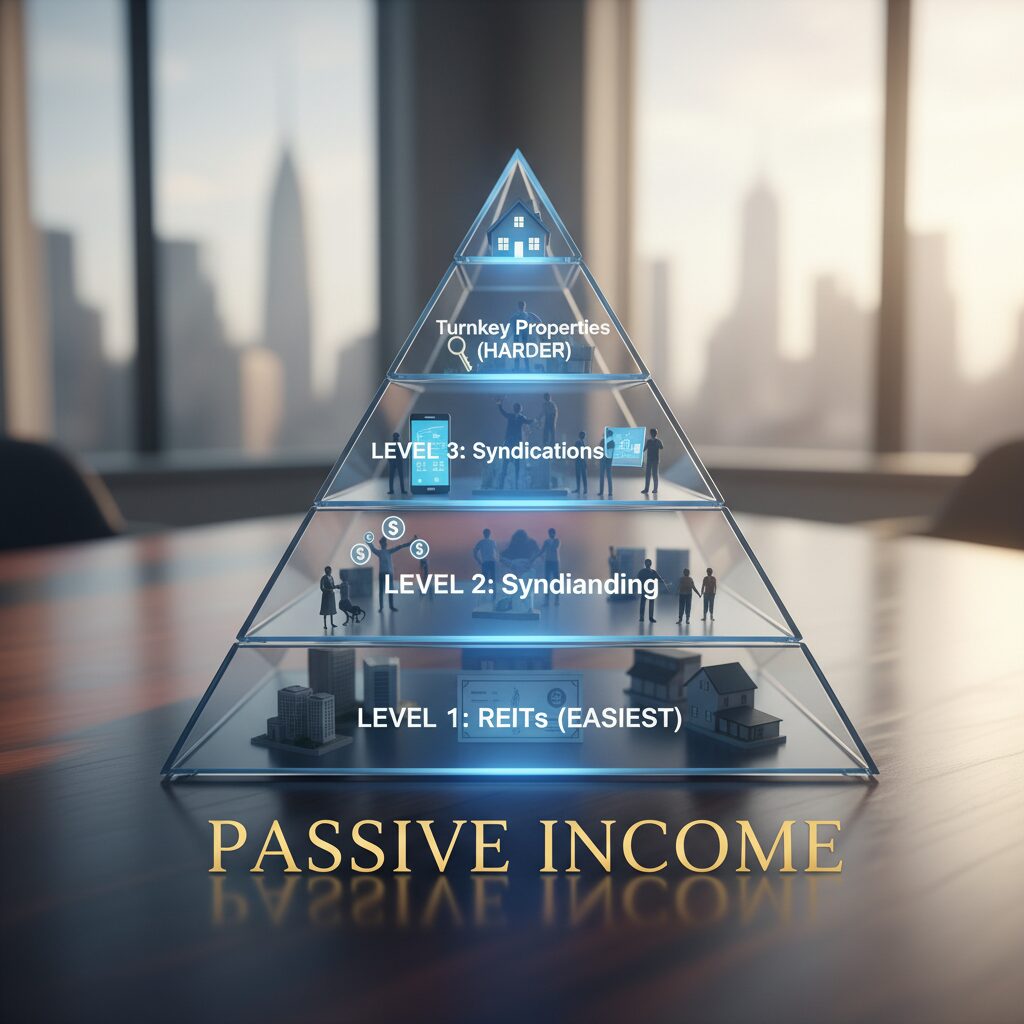
Level 1: REITs – The Easiest Way to Start (Under $100)
Effort: Near Zero Liquidity: High
If you have a brokerage account (like Fidelity, Robinhood, or Vanguard), you can start investing in real estate literally in the next five minutes. This is done through Real Estate Investment Trusts (REITs).
What is a REIT?
Think of a REIT as the “mutual fund” of the real estate world. It is a company that owns, operates, or finances income-generating real estate. By law, they must distribute at least 90% of their taxable income to shareholders annually in the form of dividends.
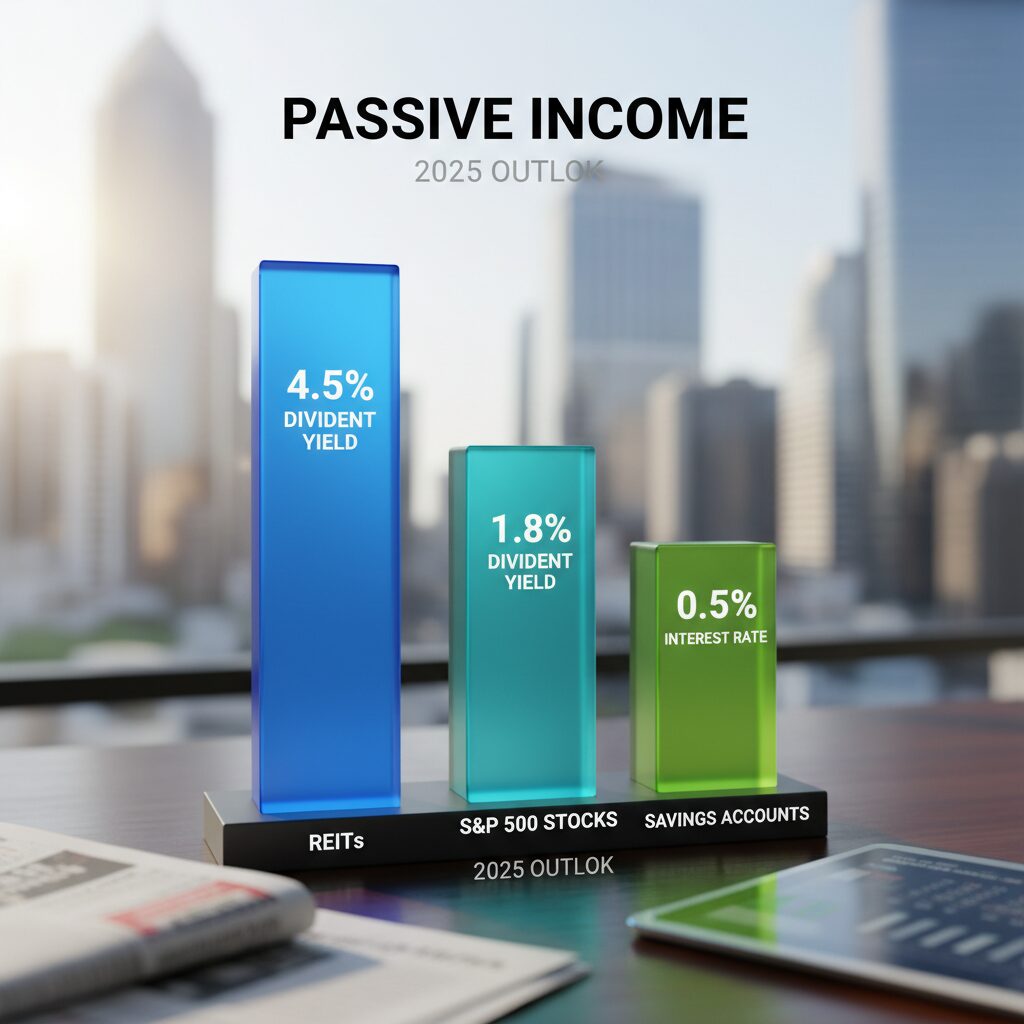
According to Uniplan Investment Counsel’s 2025 Outlook, the average dividend yield for REITs hovers between 3.5% to 5.6%, significantly outperforming the S&P 500’s average yield of roughly 1.2%.
Top Performing Sectors for 2025
Not all real estate is equal. While office buildings are struggling due to remote work, two sectors are poised for dominance in 2025:
- Residential: As noted earlier, the “rentership society” fuels companies like Invitation Homes and Mid-America Apartment Communities.
- Data Centers: With the AI boom, the physical infrastructure needed to store data is the “digital real estate” of the decade.
Case Study: The “Monthly Dividend Company”
Consider Realty Income (Ticker: O). They own thousands of commercial properties (leased to tenants like 7-Eleven and Walgreens). They have paid monthly dividends for over 54 years. In my opinion, for a beginner wanting to see immediate “mailbox money,” buying shares of a REIT like this is the psychological win you need to stay motivated.
Level 2: Real Estate Crowdfunding (The “Fintech” Approach)
Effort: Low Liquidity: Low (5+ Year Lock-up)
If REITs are the stock market version of real estate, crowdfunding is the private equity version. Platforms like Fundrise and RealtyMogul allow you to pool your money with other investors to buy specific apartment complexes or industrial parks.
How Fractional Ownership Works
Imagine a $50 million apartment complex in Dallas. You can’t buy it. But through a crowdfunding platform, you can buy a $1,000 share of it. You become a fractional owner.
The market for this is exploding. According to a 2025 report by ResearchAndMarkets, the real estate crowdfunding market is projected to grow from $20.3 billion in 2024 to $29.05 billion in 2025.
Debt vs. Equity: A Safety Check
When you log into these platforms, you’ll generally see two types of deals:
- Equity Investing: You own a piece of the property. You get a share of the rent and a share of the appreciation when it sells. (Higher risk, higher potential return).
- Debt Investing: You act as the bank. You lend money to a developer who pays you interest. (Lower risk, capped return).
In the current economic climate, debt investing is often seen as safer. Steve Haskell of RealtyMogul noted in April 2025 that while 2024 might have been the bottom of the market cycle, 2025 is shaping up to be a year of recovery, making equity deals attractive again for those with a long time horizon.

Level 3: Real Estate Syndications (For High Earners)
Effort: Medium (Due Diligence) Liquidity: Very Low
This is the “Country Club” of passive investing. A syndication is where a group of investors pools money to buy a large asset, like a 200-unit apartment building. Unlike crowdfunding apps, this is usually done through direct relationships with a “Sponsor” (the active manager).
The “Accredited Investor” Hurdle
Most syndications are open only to “Accredited Investors.” To qualify, you generally need:
- An annual income of $200,000 ($300,000 for couples) for the last two years.
- OR a net worth of over $1 million (excluding your primary home).
Why Do It?
The returns. While REITs might give you 4-5% dividends, successful syndications often target 15-20% average annual returns (Internal Rate of Return) over a 5-year hold. Plus, you get the “K-1” tax form, which passes through depreciation benefits that can significantly lower your tax bill—something you rarely get with REITs.
Level 4: “Turnkey” Rental Properties (Semi-Passive)
Effort: Medium/High Control: High
Some people just want to own the deed. They want to drive past the house and say, “I own that.” But they don’t want to fix toilets. Enter the “Turnkey” strategy.
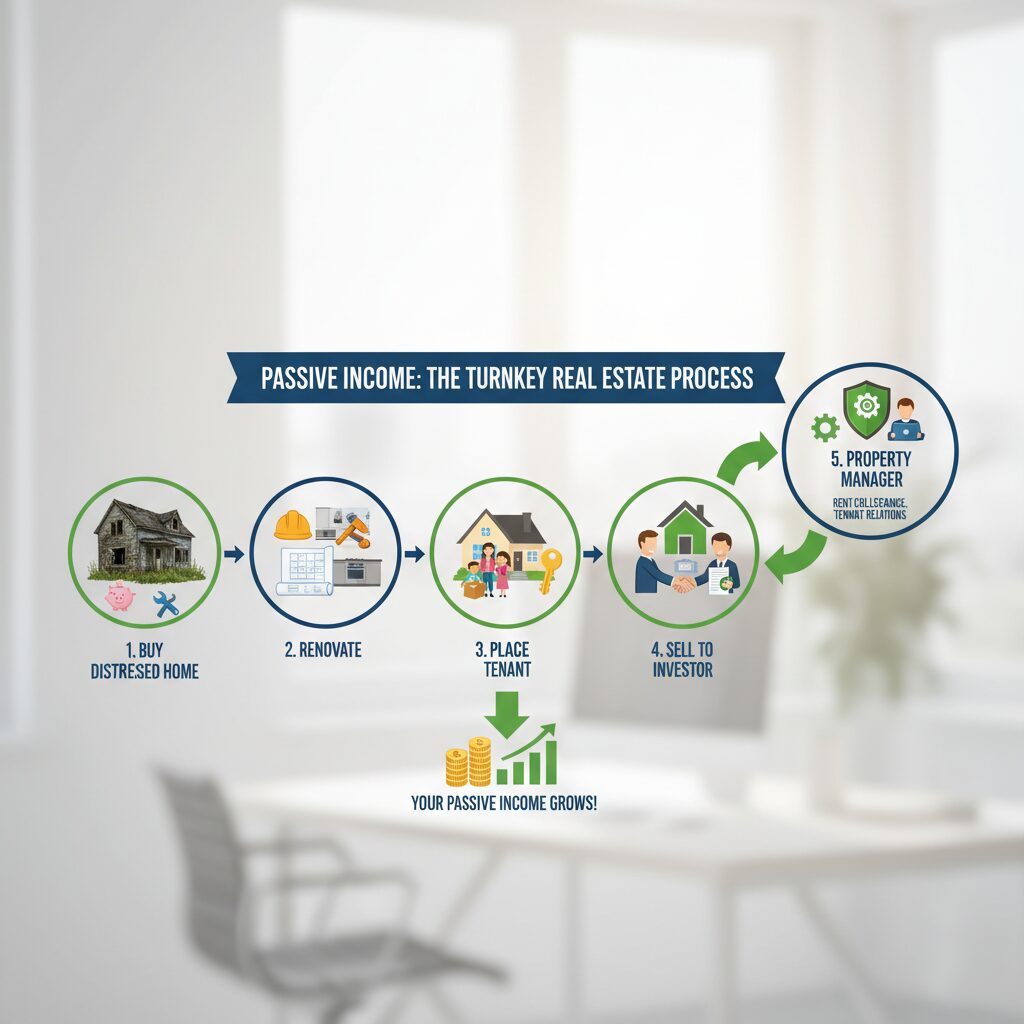
A turnkey provider finds a distressed property, renovates it, places a tenant, and then sells it to you. They also assign a property manager to handle the day-to-day.
The Crucial Role of the Property Manager
I cannot stress this enough: In turnkey investing, you aren’t buying a house; you are buying a business partner. A bad property manager will ruin your returns faster than a bad market.
Interactive Calculator: REIT vs. Rental Property
Wondering how your capital would perform? Use this simple estimator to compare a $10,000 investment in a REIT versus a down payment on a Turnkey property.
Real Risks You Must Know in 2025
It would be irresponsible of me to suggest this is risk-free. Even “passive” income requires active risk management.
1. Liquidity Risk (The “Lock-Up”)
This is the biggest shock for beginners. If you put $10,000 into a crowdfunding deal or syndication, you cannot get it back next week. Ben Miller, CEO of Fundrise, has been transparent about this, but investors still get frustrated. If you need money for an emergency, stick to Level 1 (REITs), which can be sold instantly on the stock market.
2. The Supply Shortage vs. Rate Sensitivity
While Crow Holdings reports that new multifamily construction starts have declined nearly 60% (predicting a supply shortage and rent growth), high interest rates remain a threat. If a syndication has a variable-rate loan and rates don’t drop as fast as predicted in 2025, their mortgage payments skyrocket, eating up your profit. Always ask: “Is the debt on this property fixed or floating?”
FAQ: Passive Real Estate Income
How much money do I need to start?
For Level 1 (REITs), you can start with the price of a single share, often under $100 (or even $5 for fractional shares). For Level 2 (Crowdfunding), minimums are usually $10 to $500. Turnkey properties generally require $20,000 to $40,000 for a down payment.
Is crowdfunding riskier than REITs?
Generally, yes. Publicly traded REITs are regulated by the SEC and highly transparent. Crowdfunding projects are private deals; if the specific project fails, you could lose principal. However, crowdfunding often offers higher potential returns to compensate for this risk.
How are REIT dividends taxed?
This is a crucial detail. REIT dividends are typically taxed as “ordinary income,” not the lower “qualified dividend” rate that applies to many stocks. This means you’ll pay your standard tax bracket rate on earnings. It is often wise to hold REITs in a tax-advantaged account like an IRA.
Conclusion: Match Your Capital to Your Method
The “rentership society” of 2025 has created a unique window. The gap between renting and owning is widening, and the smart money is sitting on the “landlord” side of the table—even if that landlord is a digital portfolio.
Here is your action plan:
- If you have < $1,000: Open a brokerage account and buy a Residential REIT ETF. It is the lowest risk and highest liquidity.
- If you have $5,000 – $10,000: Explore platforms like Fundrise or RealtyMogul to diversify into private assets, but be prepared to lock that money away for 5 years.
- If you have > $50,000: Look into turnkey properties or syndications to leverage tax benefits and higher equity multiples.
Real estate passive income doesn’t have to mean 3 AM maintenance calls. In 2025, it just means making a choice to be an owner rather than a tenant.
