



Best Passive Real Estate for Beginners: The 2025/2026 Profit Guide
Stop trading time for money. In late 2025, you no longer need $50k or a landlord’s toolbelt to own property.
Let’s be real for a moment. If you’re reading this in December 2025, you’ve probably heard the old advice: “Save up $50,000, buy a duplex, and become a landlord.”
That advice is outdated. It belongs in 2015.
In today’s high-rate environment, buying a physical property with a 6% mortgage and dealing with tenants isn’t just expensive—it’s a second job. That is not passive income. That is buying yourself a headache.
I’ve spent the last decade analyzing real estate trends, and the shift we’ve seen in 2025 is undeniable. The smart money isn’t flipping houses anymore. It’s moving into fractional ownership and private credit. The global real estate crowdfunding market alone reached $29.16 billion in 2025, according to Custom Market Insights, and it’s projected to quadruple by 2029.
You don’t need a fortune to get started. You need the right data. In this guide, I’m going to show you exactly where to put your money—whether it’s $500 or $5,000—to generate truly passive income while you sleep.

The “Passive” Reality Check: What Beginners Must Know in 2025
Before we dive into the platforms, we need to clear up a misconception that traps thousands of beginners every year. Turnkey properties are not passive. Even with a property manager, you are responsible for capital expenditures (CapEx). If a roof leaks in Ohio and you live in California, you are the one writing the check.
The 2025 Market Shift: Why Rates Matter
The economic landscape of late 2025 has created a unique opportunity for passive investors, specifically in the realm of debt investing.
According to the 2025 forecast by Dr. Lawrence Yun, Chief Economist at the National Association of Realtors (NAR), mortgage rates have stabilized near the 6% range. While this makes buying a physical home expensive, it makes lending money incredibly profitable.
When you invest in a “Private Credit” fund, you are essentially acting as the bank. Real estate developers borrow money from these funds to renovate properties, and they pay interest—often 8% to 10%—back to the fund. That interest flows directly to you as dividends.
“The mortgage rate is the magic bullet… rates should stabilize at the low end of the 6% range for 2025 and 2026.” — Dr. Lawrence Yun, Chief Economist, NAR.
This is why, for beginners in 2025, I prioritize debt funds over equity funds. Cash flow is king.
Strategy 1: Real Estate Crowdfunding (The “Fractional” Revolution)
Crowdfunding is the democratization of real estate. It allows you to pool your money with thousands of others to buy high-quality assets. But not all platforms are created equal.
The “Safety Play”: Private Credit Funds
If you want immediate income without waiting for a property to increase in value, this is your best option. Private credit funds lend money to professionals and distribute the interest payments to you.
🏆 Top Pick for 2025: Arrived Private Credit Fund
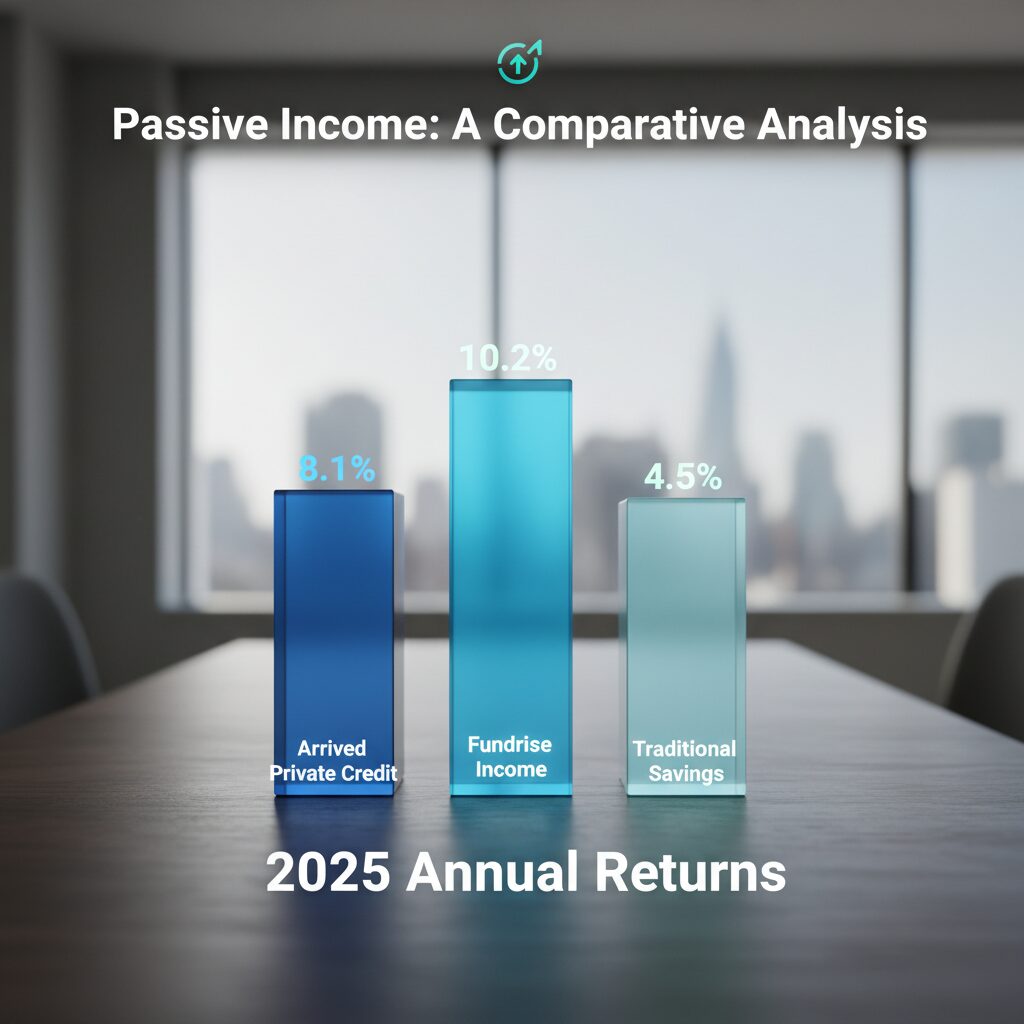
The Data: Throughout late 2024 and 2025, the Arrived Private Credit Fund paid a consistent annualized dividend. According to their September 2024 performance report, the fund delivered an 8.1% annualized yield.
Why it wins: It’s liquid enough for short-term goals, pays monthly, and is backed by real estate collateral. If a borrower defaults, the fund can foreclose on the property.
The “Growth Play”: Fractional Equity
Equity investing means you own a share of the actual house. You make money through rental income (dividends) and appreciation (when the home value goes up).
Platforms like Lofty (using blockchain) and Arrived (traditional structure) allow this. However, be aware of the returns. In 2025, median home price growth was modest at just 2% according to NAR data. This means your appreciation gains will be slower than in the boom years of 2021.
However, the Roots Real Estate Fund has defied this trend by using a unique model where tenants build equity, reducing turnover. According to their October 2025 report, the Roots Fund delivered a staggering 12.04% total return over the previous 12 months.
The “Mutual Fund” Style: eREITs
Fundrise remains the giant in this space. They created the “eREIT” (electronic Real Estate Investment Trust). In my experience using Fundrise through the high-interest era of 2024 and 2025, their Income Fund has been the star performer.
According to a December 2025 review by Financial Samurai, the Fundrise Income Fund delivered returns of 10.2%, significantly outperforming their growth funds. Why? Because high interest rates benefit lenders, and the Income Fund is primarily debt-based.
Strategy 2: Publicly Traded REITs (The Liquidity King)
If the idea of locking your money up for 5 years scares you, then Public REITs are your answer. These are companies that own real estate and trade on the stock market like Apple or Tesla.
Why REITs are safer for beginners
- Liquidity: You can sell your shares instantly on any brokerage app (Robinhood, Fidelity, Vanguard).
- Transparency: They are SEC-regulated and must report financials quarterly.
- Dividends: By law, REITs must pay out 90% of their taxable income to shareholders.
In 2025, the sectors to watch aren’t office buildings (which are struggling with remote work). The money is in Data Centers and Industrial Warehouses. As AI grows, the demand for server space skyrockets.
Strategy 3: Real Estate Syndications (For High Earners)
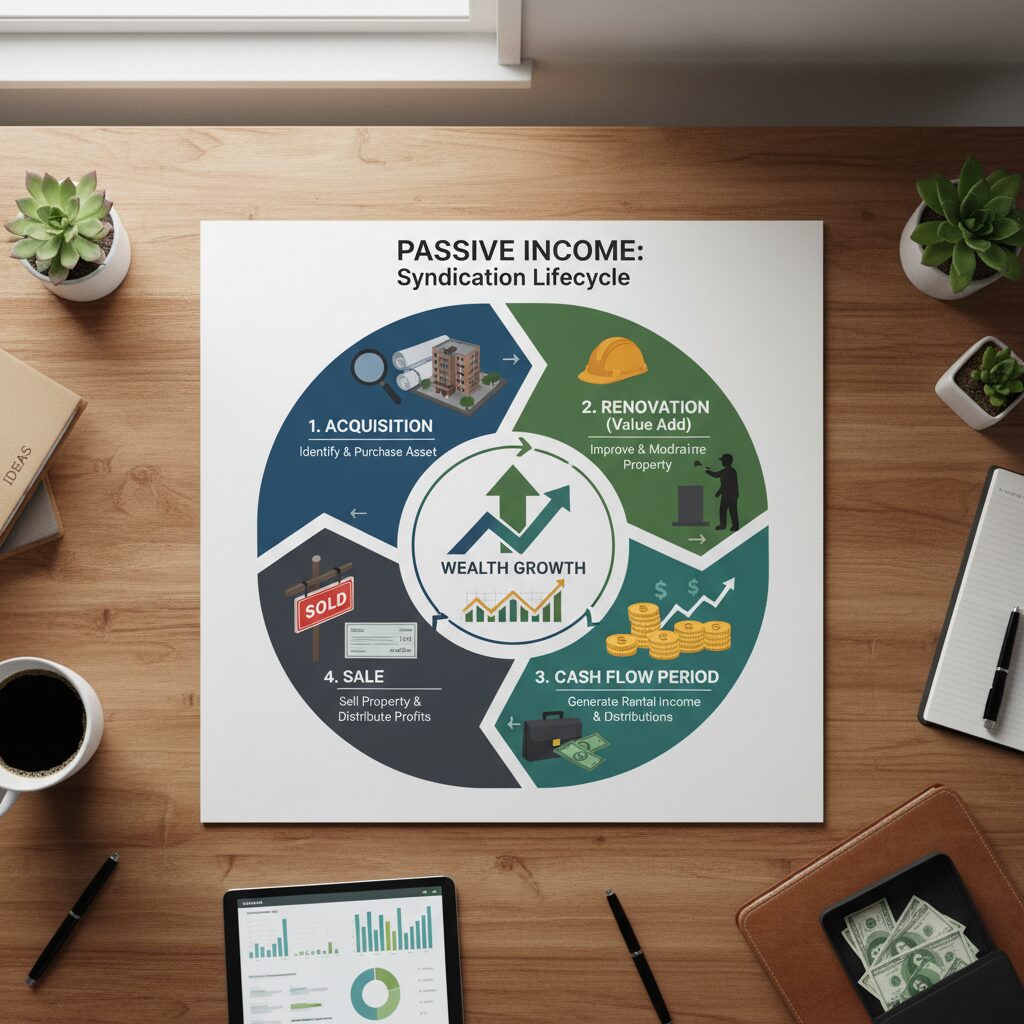
This is the “big leagues.” A syndication is when a group of investors pool money to buy a massive asset, like a 200-unit apartment complex. This is usually reserved for Accredited Investors (income over $200k/year or $1M net worth).
However, platforms like RealtyMogul have bridged this gap. They offer access to deals that were previously handshake-only.
According to RealtyMogul’s October 2024 track record, their equity syndications have realized an average Internal Rate of Return (IRR) of 18.1% on fully completed deals. That is massive.
The Catch: Your money is locked away. You cannot withdraw it until the property is sold, which usually takes 3 to 7 years. Ben Miller, CEO of Fundrise, noted in a late 2024 interview that while commercial real estate bottomed in 2023, the recovery takes time. Patience is the price of high returns.
The 2025 Tax Advantage: Bonus Depreciation
One of the biggest reasons wealthy people love real estate is the tax code. If you invest in pass-through entities (like most crowdfunding sites), you get a K-1 tax form. This often allows you to show “losses” on paper due to depreciation, even if you made cash profit.
Here is the game-changer for 2025: Following the July 2025 tax reform, 100% Bonus Depreciation has been reinstated. This allows funds to deduct the entire cost of certain improvements in year one.
What does this mean for you? It means a significant portion of your dividend income might be tax-deferred. Additionally, most of these investments qualify for the 20% Pass-Through Deduction (QBI), meaning you only pay tax on 80% of your earnings.
Comparative Table: Returns & Risk Profile
Choosing the right path depends on your budget and how long you can lock up your money. Here is the 2025 breakdown.
| Strategy | Min. Investment | Liquidity Score | Est. Yield (2025) | Best For |
|---|---|---|---|---|
| Arrived (Private Credit) | $100 | Medium (6 mos) | 8.1% | Monthly Income |
| Fundrise (Income Fund) | $10 | Medium (Quarterly) | 10.2% | Small Balances |
| Roots Fund | $100 | Medium (Quarterly) | 12.04% | Total Return |
| Public REITs (VNQ) | ~$90 (1 share) | High (Instant) | 3.5% – 4.5% | Liquidity & Safety |
| Syndications | $25,000+ | Low (3-7 Years) | 15% – 18% IRR | High Net Worth |
Interactive Calculator: The Power of Compound Interest
Curious what a 10% return looks like over time? Use this calculator to see how your passive income grows if you reinvest your dividends (compound interest).
FAQ: Passive Real Estate for Beginners
Is passive real estate investing truly passive?
Yes, if you choose the right vehicle. REITs and crowdfunding platforms are 100% passive—you invest, and they handle the tenants, toilets, and taxes. Direct ownership (being a landlord) is active investing.
Can I lose money in passive real estate?
Absolutely. All investments carry risk. In 2025, the biggest risk is property values dropping. However, Debt/Credit funds are generally safer because the borrower takes the first loss. As Mark Wiedman from BlackRock noted in their 2025 Outlook, private markets are growing, but selectivity is key.
How are passive real estate earnings taxed?
REIT dividends are usually taxed as ordinary income. Crowdfunding earnings are often passive income, which can be offset by depreciation losses. Always consult a CPA, but know that real estate is generally more tax-efficient than a standard savings account.
Conclusion: The Best Portfolio Mix for 2026
The days of needing a massive down payment to enter the real estate market are over. In the current economic climate of late 2025, staying on the sidelines is the only wrong move.
If you are a total beginner with $500, my advice is to split it. Put 50% into a Private Credit Fund (like Arrived or Fundrise Income) to secure that high 8-10% yield while rates are still elevated. Put the other 50% into a Public REIT ETF for safety and liquidity.
You don’t need to swing a hammer to build an empire. You just need to click a button.
