



Are Blue Chip Dividends Good for Passive Income?
A definitive 2025 analysis on safety, returns, and the reality of living off dividends.
Imagine a paycheck that arrives in your account whether you work, sleep, travel, or play golf—and gets a “raise” every single year, often outpacing inflation. That is the seductive promise of blue-chip dividend investing.
But does the math actually hold up in 2025?
In my years of analyzing portfolios, I’ve seen investors fall into two traps: they either chase dangerous high yields that eventually get cut, or they underestimate the massive capital required to generate a livable wage from safe stocks. With interest rates shifting and market volatility returning, the question isn’t just “are they good?”—it’s “are they safe enough for your retirement?”
In this comprehensive guide, we are going to break down the historical returns, the tax advantages that the wealthy exploit, and the exact capital you need to retire on blue chips.

What Qualifies as a “Blue Chip” Dividend Stock?
Not all dividend stocks are created equal. When we talk about “blue chips” for passive income, we aren’t talking about a speculative startup that just declared its first penny dividend. We are talking about the bedrock of the global economy.
Defining the “Wide Moat”
A true blue chip typically boasts a market capitalization exceeding $10 billion and possesses a “wide moat”—a competitive advantage that protects it from rivals. These are companies with fortress balance sheets that can weather economic storms.
According to Janus Henderson’s Global Dividend Index, global payouts hit a record $1.75 trillion in 2024, with a forecast of $1.83 trillion for 2025. This growth is largely driven by these massive, stable companies that generate surplus cash flow regardless of the economic cycle.
The Elite Tier: Aristocrats vs. Kings
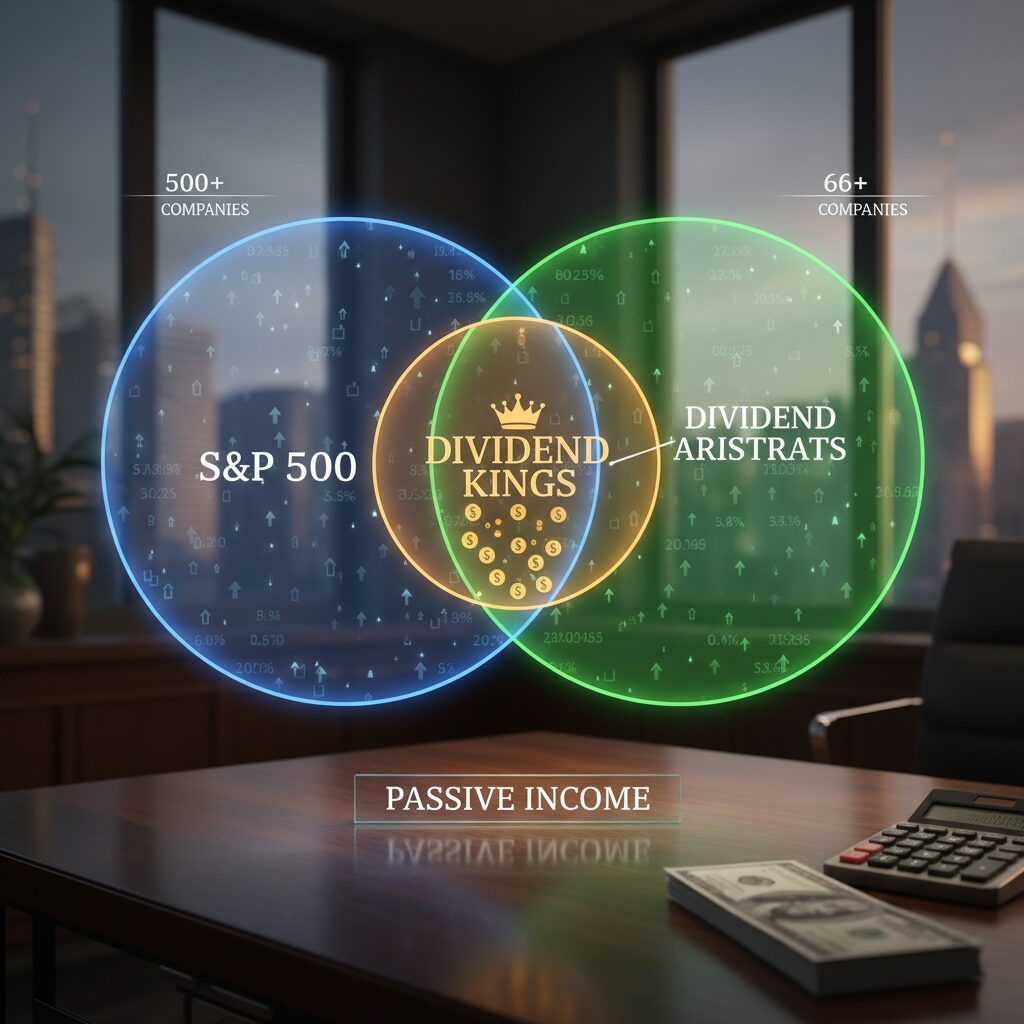
If you want safety, you need to look at the track record. In the dividend world, royalty matters:
- Dividend Aristocrats: S&P 500 companies that have increased their dividend for 25+ consecutive years.
- Dividend Kings: The rarest tier—companies that have increased payouts for 50+ consecutive years.
Think about that for a second. A Dividend King has raised its payout through the Dot-com crash, the 2008 Financial Crisis, and the 2020 Pandemic. That is the consistency passive income requires.
The Mathematical Case for Blue Chip Income
Let’s look at the hard data. Many growth investors mock dividends as “boring.” But boring makes money.
The 85% Rule
This is perhaps the most critical statistic for any long-term investor. According to a 2024 report by Hartford Funds, from 1960 through 2023, 85% of the S&P 500’s cumulative total return is attributed to reinvested dividends and the power of compounding.
STATISTIC: The Power of Compounding
If you ignored dividends and only looked at price appreciation, you missed the vast majority of the market’s historical wealth generation. The “boring” checks are actually the engine of the return.
Yield vs. Stability: The “Safe Yield” Sweet Spot
As of late 2024, the S&P 500 Dividend Aristocrats Index average yield was approximately 2.5%, compared to the broader S&P 500 yield of roughly 1.14%, according to data from S&P Dow Jones Indices.
Warning: You might be tempted to look for stocks paying 8% or 10%. In my experience, these are often “yield traps”—companies with falling share prices that artificially inflate the yield. A safe payout ratio (the percentage of earnings paid out as dividends) for a blue chip is usually between 30% and 60%. Currently, the S&P 500 payout ratio sits at a healthy 35.78%, according to Ned Davis Research, indicating plenty of room for safety.
Blue Chip Dividends vs. Other Passive Income Streams
How do blue chips stack up against the other titan of passive income: Real Estate?
| Feature | Blue Chip Dividends | Rental Real Estate |
|---|---|---|
| Passivity | 100% (Do nothing but hold) | Low-Medium (Tenants, toilets, trash) |
| Liquidity | Instant (Sell in seconds) | Low (Months to sell) |
| Entry Cost | Low ($1 for fractional shares) | High (Down payments) |
| Tax Efficiency | Qualified rates (0-20%) | Depreciation & write-offs |
While real estate allows for leverage, blue chip dividends offer true “sleep well at night” passivity. You don’t get a call at 2 AM because Coca-Cola’s roof is leaking.
The “Living Off Dividends” Reality Check
Can you actually retire on this? Let’s run the numbers for a theoretical retiree we’ll call “John,” aged 65.
Scenario: The “Safety First” Portfolio
John sells his business and invests $1,000,000 into a Dividend Aristocrat ETF (like NOBL) yielding the average 2.5%.
- Annual Passive Income: $25,000
- Monthly Income: ~$2,083
This sounds low compared to a 4% withdrawal rate ($40,000), but here is the magic: Capital Preservation. John is spending the dividends without touching the principal. Furthermore, Dividend Aristocrats have historically grown their payouts by roughly 5-8% annually.
— Christine Benz, Director of Personal Finance at Morningstar (August 2024)
In five years, assuming a conservative 7% dividend growth rate, John’s income could rise to roughly $35,000 without him adding a single penny or selling a single share. This provides a critical hedge against inflation.
Interactive: Dividend Growth Calculator
Use this calculator to see how a Dividend Reinvestment Plan (DRIP) can accelerate your wealth during your accumulation phase.
💰 Dividend Snowball Calculator
Tax Implications of Dividend Income in 2025
One of the most overlooked benefits of blue chip dividends is their tax treatment. Not all income is taxed equally by the IRS. In my opinion, this is the secret weapon of the wealthy.
Qualified vs. Non-Qualified
Most blue chip dividends (from U.S. corporations held for more than 60 days) are considered “Qualified Dividends.” Instead of being taxed at your ordinary income tax rate (which can go up to 37%), they are taxed at long-term capital gains rates.
According to IRS Revenue Procedure 2024-40, the 2025 brackets for qualified dividends are highly favorable:
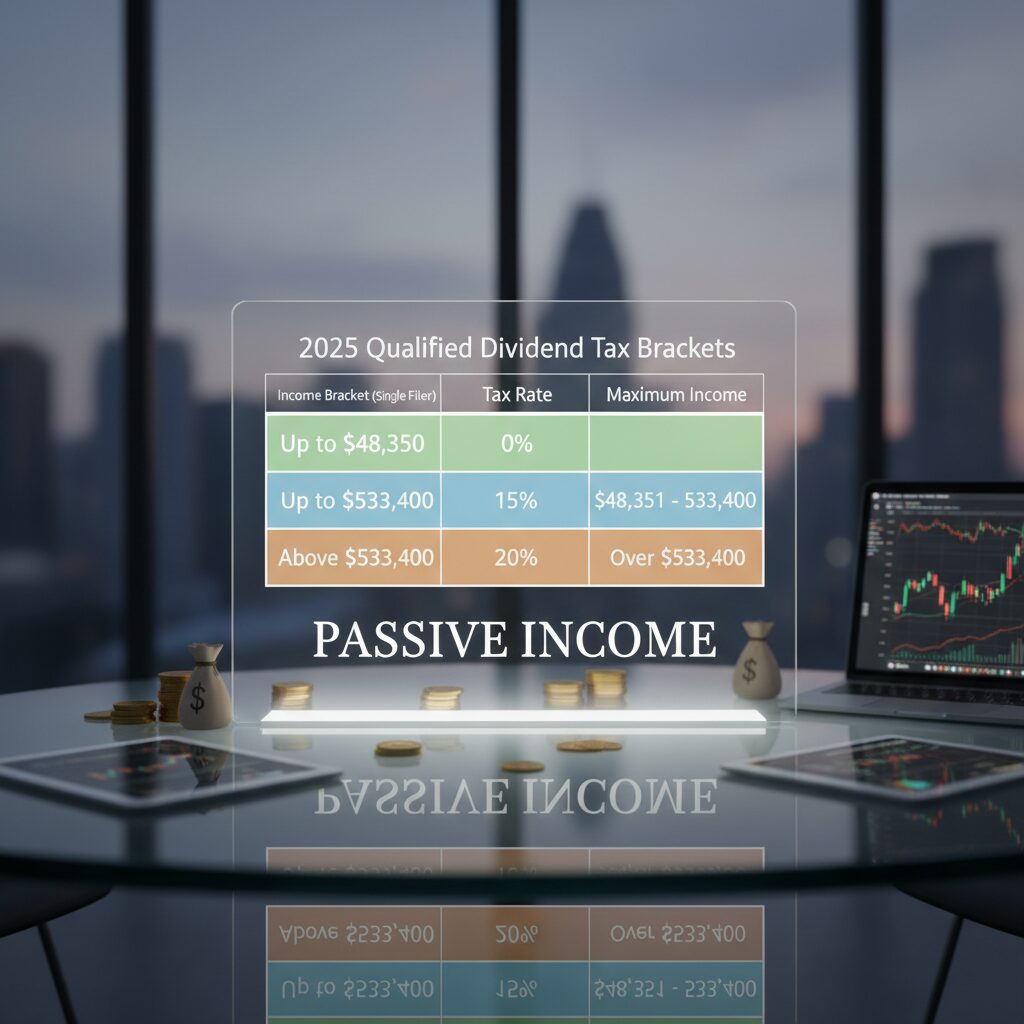
The Strategy: If you are a married couple filing jointly with $90,000 in taxable income, your qualified dividends are likely taxed at 0% or 15%. Compare that to interest from a High-Yield Savings Account (HYSA) or bonds, which are taxed as ordinary income. A 3% qualified dividend yield can be mathematically equivalent to a 4.5% bond yield once you factor in taxes.
How to Build Your Blue Chip Machine
So, how do you actually start? You have two main paths: Stock Picking or ETFs.
1. The “Rule of 20” (Stock Picking)
If you choose to buy individual stocks (like Johnson & Johnson, Procter & Gamble, or Realty Income), you need diversification. I always recommend the “Rule of 20″—holding at least 20 stocks across different sectors (Healthcare, Staples, Tech, Utilities) to mitigate the risk of a single company cutting its dividend.
Note on Tech: The landscape is shifting. Jane Shoemake, Client Portfolio Manager at Janus Henderson, noted in March 2025 that tech giants are the new dividend growers: “Tech giants are proving that they are just like successful companies before them: as they start to mature, they begin to generate surplus cash.”
2. The ETF Route (Recommended for Most)
For true passive income, ETFs are superior. You get instant diversification and automatic rebalancing.
- SCHD (Schwab US Dividend Equity ETF): Focuses on sustainable payouts.
- NOBL (ProShares S&P 500 Dividend Aristocrats): Only holds companies with 25+ years of growth.
- VIG (Vanguard Dividend Appreciation): Focuses on dividend growth rather than high yield.
FAQ: Passive Income with Blue Chips
Yes. Stocks are equity assets. While the income from blue chips is generally stable, the principal value fluctuates. However, data from an S&P Dow Jones 2025 Factsheet shows that Dividend Aristocrats have outperformed the S&P 500 in down markets 66.67% of the time since 1989.
It depends on your lifestyle. If you need $50,000 in annual passive income and target a safe 3% yield, you need approximately $1.66 million invested. This underscores why dividend investing is a long-term wealth preservation strategy, not a “get rich quick” scheme.
Technically, the IRS classifies dividends as “portfolio income,” not “passive activity income” (which usually refers to real estate or business activities). However, because qualified dividends enjoy the 0%, 15%, or 20% tax rates, they are among the most tax-efficient forms of income available.
Conclusion: The Verdict for 2025
Are blue chip dividends good for passive income? The answer is a resounding yes, provided you understand the timeline. They are not a mechanism for overnight riches. They are a mechanism for unshakeable financial freedom.
The data from Hartford Funds and Janus Henderson is clear: dividends drive the majority of long-term market returns. By focusing on blue-chip companies with “wide moats,” favorable payout ratios, and a history of raising dividends, you build a paycheck that inflation cannot destroy.
Your Next Steps:
- Audit your portfolio: Are you chasing dangerous high yields (>7%)?
- Check your diversification: Do you own at least 20 stocks or a solid ETF like SCHD?
- Enable DRIP: If you are in the accumulation phase, let those dividends compound.
Disclaimer: I am a financial content specialist, not a certified financial advisor. Market data and tax laws are subject to change. Always consult with a qualified professional before making investment decisions.
