


How to Create a Fully Automated Online Store in 2025 (The AI-Driven Guide)
Imagine waking up to the “cha-ching” sound of sales notifications on your phone for products you didn’t pack, ship, or manually market. It sounds like the typical internet “get rich quick” pitch, right? But here is the reality: automation isn’t about getting rich quick; it’s about reclaiming your time through intelligent systems.
In 2025, the barrier to entry for ecommerce is lower than ever, but the barrier to profitability is higher. The difference between a store that burns you out and one that scales is automation. According to Sobot’s 2025 Ecommerce Trends Report, 92% of top retailers are now using AI to handle personalization and operations. If you aren’t automating, you aren’t just working harder—you’re falling behind.
In my years consulting for ecommerce brands, I’ve seen business owners drowning in manual CSV uploads and customer support tickets. I’ve also seen the other side: solo founders running seven-figure stores with a tech stack that does 80% of the work. This article is your architectural blueprint to build the latter.

The “Autopilot” Business Model: How It Works
Before we touch a single tool, you need to understand the philosophy. “Automated” does not mean “absent.” You are the pilot; the software is the autopilot. You set the course, and the machine flies the plane.
The modern automated store relies on three pillars:
- Automated Fulfillment: Orders flow from checkout to supplier without you touching a button.
- AI Marketing: Traffic is acquired and retargeted via programmatic SEO and agentic ad flows.
- Self-Healing Support: AI agents handle “Where is my order?” tickets instantly.
Source: Statista (2025 Forecast)
Dropshipping vs. POD vs. Digital Products
Not all business models automate equally. While high-ticket dropshipping automation is popular, selling digital products offers the cleanest “delivery” automation because there is no physical shipping delay.
However, physical goods are where the volume is. The key is using dropshipping automation tools like AutoDS or DSers that sync inventory levels in real-time. If a supplier runs out of a blue XL t-shirt, your store should automatically mark it as “Sold Out” or hide it. If you’re doing this manually, you’ve already lost.
Step 1: Choosing Your Automation-First Platform
You can’t automate a store built on a closed system. You need an ecosystem that speaks the language of APIs. In my opinion, there are really only two serious contenders for 2025.
Shopify + Shopify Flow (Best for Beginners)
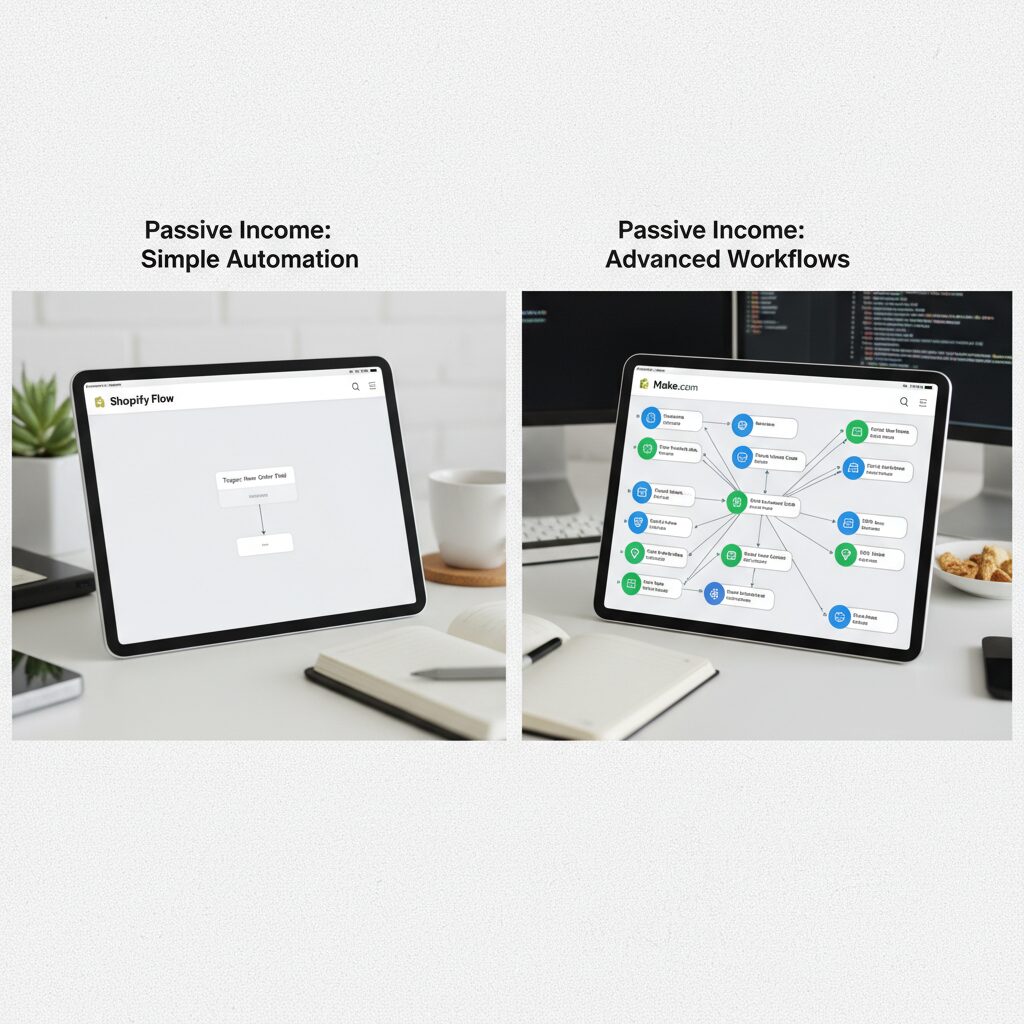
Shopify remains the king of integration. Their native automation tool, Shopify Flow, allows you to build logic without coding. For example, you can create a rule: “If an order is over $100, tag the customer as VIP and send a thank you email.”
“We have evolved from an online store to a comprehensive unified operating system for commerce anywhere, anytime. We understand that starting a business is hard. As our merchants grow, Shopify tackles these challenges so they don’t have to.”
— Harley Finkelstein, President of Shopify (Source: Shopify Future of Commerce)
WooCommerce + Make.com (Best for Technical Freedom)
If you want to avoid monthly fees and own your data, WooCommerce is the answer. However, WooCommerce automated stores require external “glue.” This is where Make.com (formerly Integromat) shines. Unlike Shopify Flow, Make allows you to connect WooCommerce to virtually anything—Google Sheets, Slack, OpenAI, or obscure logistical carriers—handling complex data transformation that other platforms can’t touch.
Step 2: Automating Product Sourcing & Fulfillment
This is the backbone of your store. If you are manually copying customer addresses into AliExpress or a supplier portal, you are running a hobby, not a business.
The “No-Touch” Fulfillment Chain
To set up an automated dropshipping workflow, you need middleware software. Tools like AutoDS or DSers act as the bridge between your store and the supplier.
How the setup works:
- Product Import: You use a browser extension to “grab” products from suppliers (AliExpress, CJ Dropshipping, Amazon) and push them to your store.
- Price Optimization: You set an automated pricing rule. Example: Cost Price x 2.5 = Retail Price. If the supplier raises their price, the software automatically raises yours to protect your margin.
- Order Processing: When a customer buys from you, the software detects the order, uses your credit card to buy it from the supplier, and inputs the customer’s address.
- Tracking Write-Back: When the supplier ships the item, the tracking number is automatically pulled back into your store and emailed to the customer.
This cycle happens 24/7. Your only job is ensuring your funding source (credit card) doesn’t hit its limit.
Step 3: Building the AI Marketing Engine
Fulfillment keeps the store running; marketing automation makes it grow. This is where the biggest revenue gains are found.
Automated Email Flows: The Revenue Multiplier
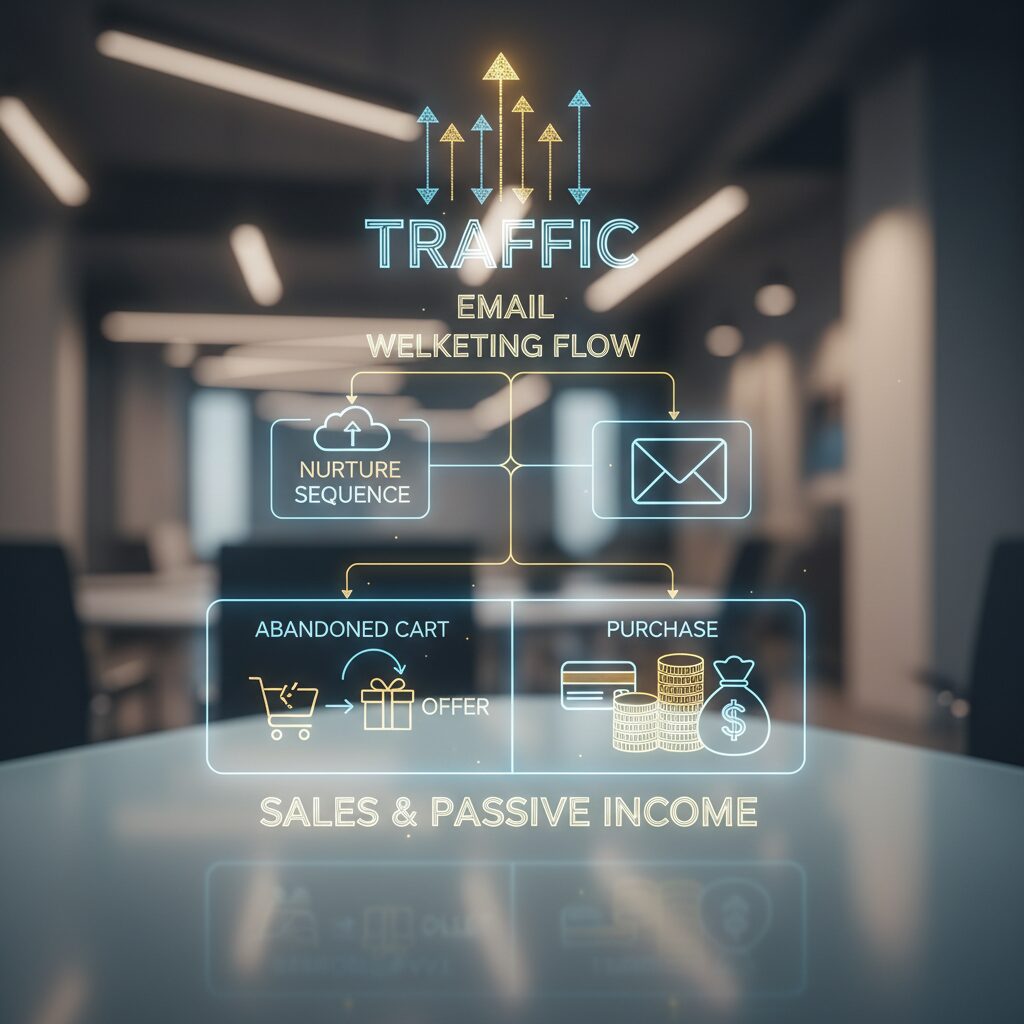
Most beginners send “broadcast” emails (newsletters). Pros use “flows” (behavior-based triggers). According to data from ContactPigeon and Omnisend, automated email campaigns generate 320% more revenue than non-automated ones.
You need to set up these three flows immediately in a tool like Klaviyo:
- Welcome Series: Triggers when someone joins your list. (Omnisend 2024 data shows these have a 52.9% open rate vs 20% for standard emails).
- Abandoned Cart Recovery: Triggers 1 hour after checkout abandonment. Firework / Moosend Studies 2024 show these can recover up to 25% of lost sales.
- Post-Purchase Upsell: Triggers 14 days after purchase, suggesting complementary products.
Generative AI for Content
In the past, you had to hire copywriters. Now, Sobot’s 2025 report indicates that 77.2% of ecommerce professionals use AI tools daily.
You can automate your product descriptions using ChatGPT APIs linked to your store. You feed the technical specs (size, material) into the API, and it returns a persuasive, SEO-optimized description and meta-tag. This is essential for ecommerce programmatic SEO, where you might need to generate hundreds of landing pages for different product variations.
Step 4: The “No-Human” Customer Support System
Customer service is the number one time-killer for store owners. “Where is my order?” (WISMO) accounts for a massive chunk of inquiries.
By 2030, chatbots and AI agents are projected to handle 80% of all customer service interactions, according to Juniper Research data. But we aren’t talking about the dumb chatbots of 2020. We are talking about AI Agents like Gorgias AI or Tidio.
These tools connect to your Shopify backend. When a customer asks, “Where is my stuff?”, the AI:
- Identifies the customer by email.
- Checks the real-time order status.
- Responds: “Hi Sarah, your order #1024 is currently in transit and is expected to arrive by Thursday. Here is the tracking link.”
It does this in seconds, costing you zero minutes of labor. This level of personalization is critical; McKinsey’s 2024 report notes that 71% of consumers expect companies to deliver personalized interactions.
“While new technology, including generative AI tools, offer new ways to engage consumers and drive crucial efficiencies, brands should continue to maintain a personal touch.”
— Deann Evans, MD EMEA at Shopify (Source: Electronic Payments International, June 2024)
Step 5: Connecting the “Brain” (Zapier/Make Integrations)
To truly reach “level 5” automation, you need to connect your apps. This is where tools like Zapier come in. Through my work automating workflows, I’ve found these 5 “Zaps” to be essential for every store owner:
| Trigger (When this happens…) | Action (Do this automatically…) | Why it matters |
|---|---|---|
| New Order in Shopify | Add row to Google Sheets | Creates a backup database for accounting and analytics outside your platform. |
| New Order > $100 | Send Slack/Teams Notification | Keeps your team motivated and alerted to VIP customers without checking the store. |
| Bad Review (1-2 Stars) | Create Task in Trello/Asana | Ensures negative feedback is addressed immediately by a human (Human-in-the-loop). |
| New Customer Email | Add to Custom Facebook Audience | Automates your retargeting ad lists so you aren’t manually uploading CSVs. |
Furthermore, automating your finances is non-negotiable. Integrating tools like QuickBooks or Xero directly with your store ensures that sales tax and revenue are recorded instantly. This alone saves dozens of hours during tax season.
Automation Potential Calculator
Curious how much time you could save? I built this simple calculator based on average task times I’ve observed in the industry.
Time Savings Estimator
Step 6: The Financial Reality & Risks
Is this a scam? Is it really “passive”? These are the questions I see in forums constantly. The answer is nuanced.
Building the system requires active, intense work. Once built, the operation is passive, but the maintenance is not. You must monitor your APIs, check for broken links, and update your ad creatives. Automation manages the known; humans manage the unknown.
Furthermore, Generative AI is changing the value proposition. McKinsey’s State of AI 2024 report suggests Generative AI could unlock between $400 billion and $660 billion in annual value for retail. The risk isn’t that automation won’t work; the risk is that your competitors will use it to undercut you on price and speed while you are still manually printing shipping labels.
FAQ: The Truth About “Passive” Ecommerce
Can you fully automate an online store 100%?
Technically, no. You can automate 90-95% of operations (fulfillment, emails, basic support). However, high-level strategy, selecting new product niches, and creative direction still require a human brain. If you automate 100%, you usually end up with a spammy, low-quality store that Google will penalize.
What is the best automated dropshipping software in 2025?
For Shopify users, AutoDS is currently the leader due to its wide range of suppliers and “Fulfilled by AutoDS” service. For those on a tight budget using AliExpress specifically, DSers remains the standard for bulk order processing.
How much passive income can an automated store make?
This varies wildly. A well-optimized automated store can generate anywhere from $1,000 to $50,000+ monthly. However, “passive” refers to the fulfillment method, not the lack of effort in setting it up. Margins in dropshipping are typically 15-20%, whereas POD or digital products can see 30-80% margins.
Conclusion: The Architect vs. The Laborer
Creating an automated online store is about changing your identity as a business owner. You must stop being the laborer who moves the boxes and start being the architect who designs the system.
The tools exist. The data confirms that automation is where the market is heading. The only variable left is your willingness to learn the “tech stack” instead of just the “sales tactics.”
Start small. Automate your welcome emails today. Next week, automate your fulfillment. Month by month, remove yourself from the equation until you are left with a business that serves you, rather than a job you created for yourself.
