


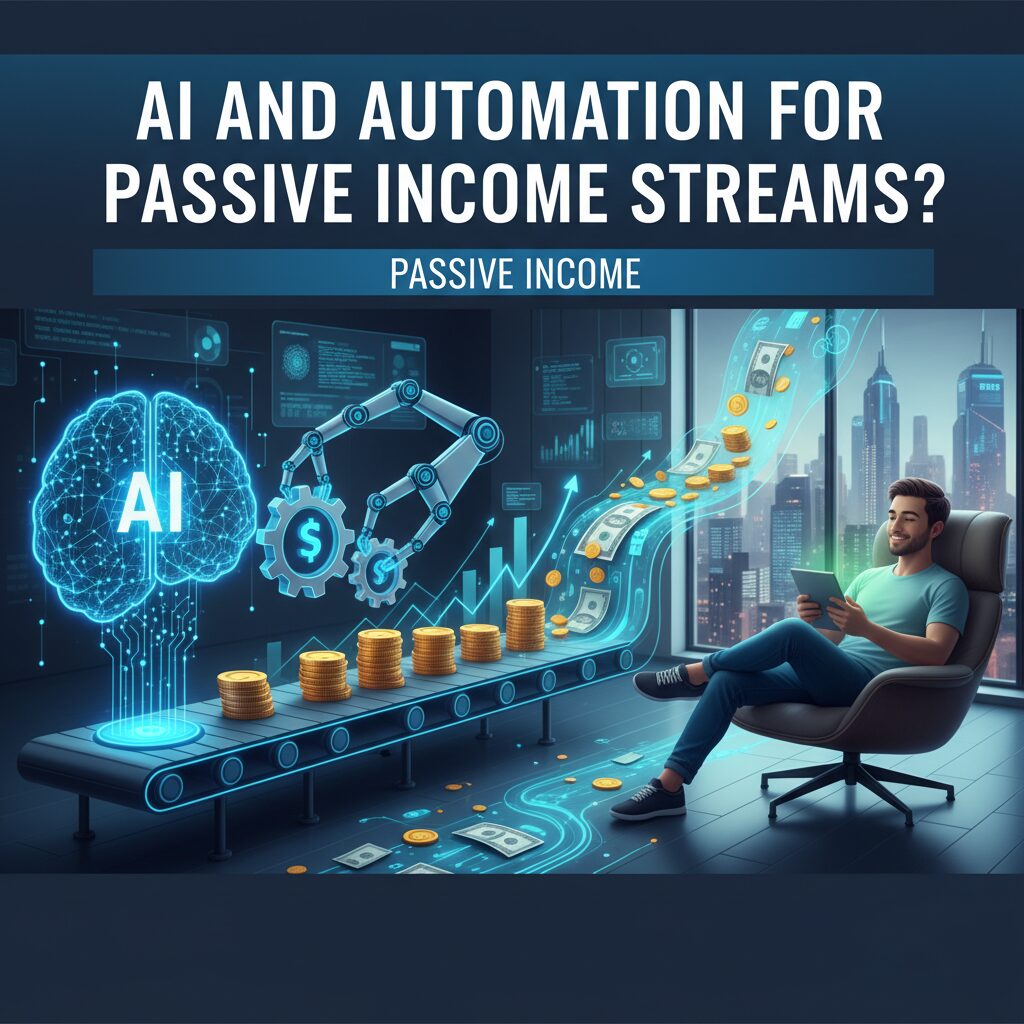
AI Passive Income in 2025: The Blueprint for Automated Wealth Generation
I remember sitting in a coffee shop back in 2018, trying to “scale” my freelance writing business. The equation was brutal: if I stopped typing, the money stopped flowing. I was trading hours for dollars, a trap that 99% of workers find themselves in.
Fast forward to today, and the landscape has fundamentally shifted. We aren’t just looking at new tools; we are looking at a new economic reality. As Naval Ravikant famously noted in The Almanack of Naval Ravikant, “Code and media are permissionless leverage.” For decades, accessing that leverage required you to be a master coder or a media mogul.
Not anymore.
With the rise of Generative AI, the barrier to entry for creating assets—things that pay you while you sleep—has collapsed. But let’s be clear: this isn’t about pushing a magic button and waiting for cash to fall from the sky. It’s about building systems.
In this guide, we are going to dismantle the “get rich quick” myths and replace them with verified, data-backed workflows. We will explore how to use AI not just to work faster, but to build assets that work for you.
The Economics of AI Automation (Why Now?)
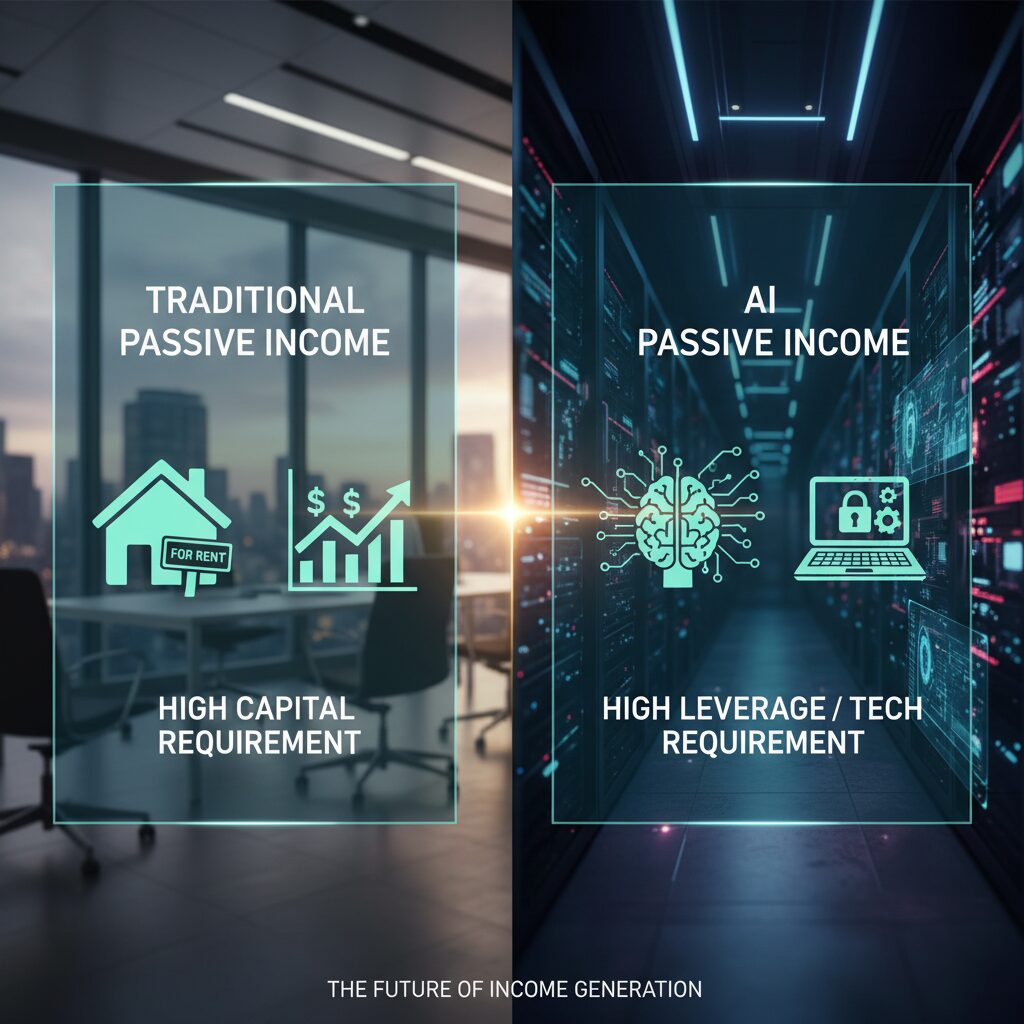
Before we dive into the “how,” you need to understand the “why.” If you think AI is just a bubble, the financial data suggests otherwise. We are witnessing a massive transfer of value from labor to leverage.
This growth is fueled by a radical increase in efficiency. A study from MIT Sloan (2023) found that generative AI can increase the productivity of highly skilled workers by up to 40%. For the solo entrepreneur, this is the equivalent of hiring a team of experts for $20 a month.
The Shift from Labor to Leverage
In the past, starting a side hustle meant working a “second shift” after your day job. Today, Americans are increasingly relying on side income. Bankrate’s 2023 Side Hustle Survey reveals that 39% of U.S. adults have a side hustle, and 28% believe they will always need one to make ends meet.
The difference in 2025 is that AI allows you to decouple your time from your output. As McKinsey & Company (2023) reports, current technology has the potential to automate work activities that absorb 60 to 70 percent of employees’ time. The opportunity lies in capturing that freed-up time and directing it toward asset creation.
7 Verified AI Passive Income Streams
I have analyzed dozens of business models to filter out the noise. Below are seven workflows that use AI as a force multiplier, not just a gimmick.
1. The “Faceless” Media Empire (YouTube & Social)
You don’t need to be an influencer to make money on video platforms. The “Faceless Channel” model involves creating content—histories, mysteries, meditation, or educational summaries—without ever appearing on camera.
The Opportunity: Video consumption is at an all-time high. Alphabet’s Q3 2023 Earnings Call revealed that YouTube Shorts are averaging over 70 billion daily views. That is a massive ocean of traffic to tap into.
The AI Workflow:
- Scripting: Use Claude 3 or GPT-4o to generate engaging scripts based on trending topics.
- Voiceover: Use ElevenLabs for hyper-realistic, human-like narration.
- Visuals: Use InVideo AI or stock footage aggregators to match clips to your audio automatically.
My Take: The key here is consistency. A single video rarely goes viral. But an automated pipeline that produces 3 high-quality videos a week builds a library of assets that generate AdSense revenue for years.
2. Hyper-Niche Blogging & Affiliate Engines
Blogging isn’t dead; lazy blogging is. Competitors will tell you to mass-produce 100 articles a day. Don’t do this. Google’s 2024 Core Updates have cracked down on “scaled content abuse.”
Instead, use AI for “Programmatic SEO” with a human touch. eMarketer (2023) notes that 73% of US marketers are already using AI tools. To compete, you must use AI for data analysis and structure, not just writing.
The Strategy:
- Use AI to analyze 50 top-ranking articles for a keyword like “Best CRM for Dentists.”
- Ask the AI to identify the “information gaps”—what are competitors missing?
- Generate the article outline and draft, then spend your time adding personal expertise and verified data.

3. Selling AI-Generated Digital Assets (Etsy/Stock)
Digital products are the holy grail of passive income because they have zero marginal cost of replication. Shopify’s Business Guide highlights that digital products often command margins ranging from 50% to 100%.
You can use tools like Midjourney to create seamless patterns, textures, and digital planners. These can be sold on Etsy or creative marketplaces.
4. Micro-SaaS & GPT Wrappers (No-Code)
NVIDIA CEO Jensen Huang famously said in a 2023 Keynote that “Everyone is a programmer now… You just have to say something to the computer.”
You can now build “Micro-SaaS” (Software as a Service) applications without writing a line of code. By combining a frontend tool like Bubble or FlutterFlow with the OpenAI API, you can solve specific problems.
Example: A tool that helps real estate agents write listing descriptions from photo uploads. The AI does the work; your app charges a monthly subscription. Gartner forecasts that by 2025, 70% of new applications will use low-code or no-code technologies.
5. Print-on-Demand (POD) Automation
Print-on-demand involves selling custom designs on t-shirts, mugs, or posters where a third party (like Printful) handles shipping. You never touch inventory.
The AI Twist: Use Midjourney to generate niche-specific art (e.g., “Retro 80s Synthwave Cat”). Upscale the image using AI tools like Topaz Gigapixel to ensure print quality, then automate the listing process to Shopify or Etsy.
6. Automated Education (Courses & E-books)
The demand for knowledge is insatiable. Goldman Sachs predicts the creator economy could approach $480 billion by 2027. AI can help you capture a slice of this by acting as your instructional designer.
Don’t just ask ChatGPT to “write a book.” That creates generic garbage. Instead, use it to:
- Design a comprehensive curriculum based on best-selling courses.
- Generate quizzes and worksheets.
- Summarize complex research papers for your students.
7. Algorithmic Trading & Finance
This is the most advanced—and risky—stream. AI bots can analyze market sentiment and execute trades faster than humans. GitHub research shows developers code up to 55% faster with Copilot, making it easier for individuals to write their own trading scripts in Python.
Note: This requires capital and carries the risk of loss. It is not for beginners.
The “Tech Stack” for Total Automation
To pull this off, you need the right tools. I call this the “Automation Triad.”
| Component | Role | Recommended Tools |
|---|---|---|
| The Brain | Generates logic, text, and decisions. | GPT-4o, Claude 3.5 Sonnet, Gemini 1.5 Pro |
| The Glue | Connects apps (moves data from A to B). | Zapier, Make.com (formerly Integromat) |
| The Hands | Executes actions (browsing, posting). | AutoGPT, Bardeen.ai, Hexomatic |
Critical Risks & Ethical Guardrails
It would be irresponsible of me to paint a purely rosy picture. Automating income has pitfalls.
Platform Dependency (“Sharecropping”)
If you build your entire business on ChatGPT wrappers or YouTube algorithms, you are building on rented land. OpenAI could release a feature tomorrow that destroys your micro-SaaS. Always aim to own your audience (email lists) and your data.
The “Human in the Loop” Necessity
Professor Ethan Mollick of Wharton famously wrote on his One Useful Thing blog: “The cost of creating content has dropped to zero. The value of verified human connection has skyrocketed.”
If your content feels automated, people will ignore it. Capgemini Research Institute found that while 62% of consumers are comfortable with AI, they crave transparency. The most successful passive income streams use AI to do the heavy lifting, but use a human for quality control and strategy.
FAQ: AI Income Realities
Can you legally sell AI-generated art?
Yes, you can sell it, but you cannot copyright the raw output. This means others could theoretically use your raw image if they got access to it. However, the value usually lies in the curation, the product application (like a t-shirt), or the brand you build around it, not just the raw jpeg.
Is this actually “passive”?
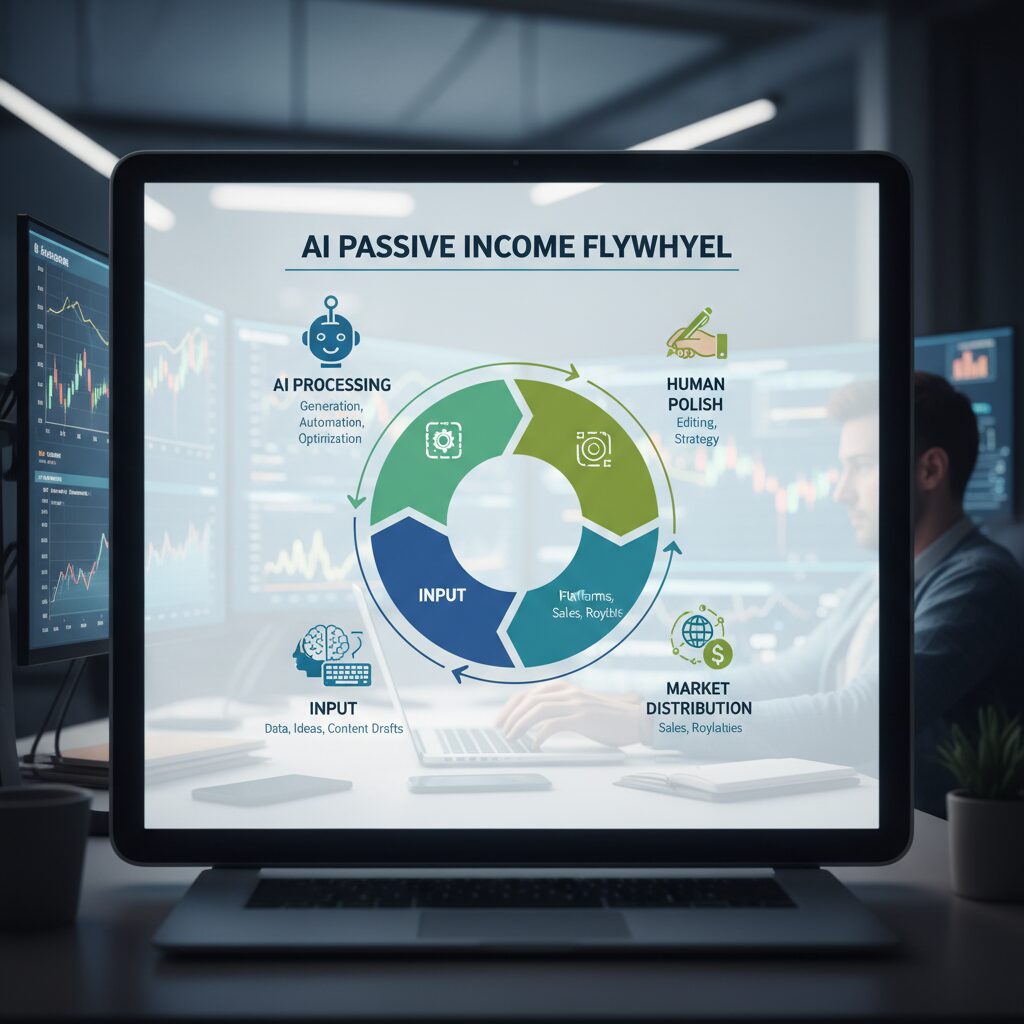
In the beginning? No. It requires significant upfront effort to build the system (the “flywheel”). However, once the workflow is established—for example, a print-on-demand store with 500 designs—the maintenance time drops drastically compared to traditional employment.
Does Google penalize AI content?
Google has explicitly stated they reward high-quality content regardless of how it is produced. However, they aggressively penalize “scaled content abuse”—mass-produced, low-value AI spam. If you use AI, you must add unique value, data, or perspective.
Conclusion: Stop Waiting, Start Automating
We are living through a technological revolution comparable to the internet boom. Sam Altman, CEO of OpenAI, stated in an ABC News interview that AI “is going to be the greatest tool for humanity… it is an amplifier of human ability.”
The “passive” income of the future isn’t about finding a loophole. It’s about becoming an architect. It’s about designing systems where AI handles the repetitive execution, allowing you to focus on creativity and strategy.
My advice? Do not try to launch all seven streams at once. Pick one. Master the workflow. Build the asset. Then, and only then, let it run while you build the next one.
The tools are ready. The economy is shifting. The only variable left is you.
