


15 Low Maintenance Automated Business Ideas for 2025 (Data-Backed)
Why the “4-Hour Work Week” is outdated and how Agentic Commerce is the new standard.
We need to have an honest conversation about the “4-Hour Work Week.” It’s an archaic concept. In 2025, if you are working four hours a week on operations, you are likely losing to someone using AI to do it in four minutes.
The landscape has shifted. We are entering the era of “Agentic Commerce”—a paradigm where AI agents handle the heavy lifting of customer service, sales, and even fulfillment. This isn’t science fiction; it’s the current economic reality.
According to McKinsey & Company’s October 2025 report on Agentic Commerce, this shift “will not just enhance the way we buy and sell—it’s a potential paradigm shift that could redefine the entire commercial ecosystem.”
Below, I break down the specific business models that leverage this shift. These are categorized by their “Touch Level”—the amount of human intervention required once the system is live.
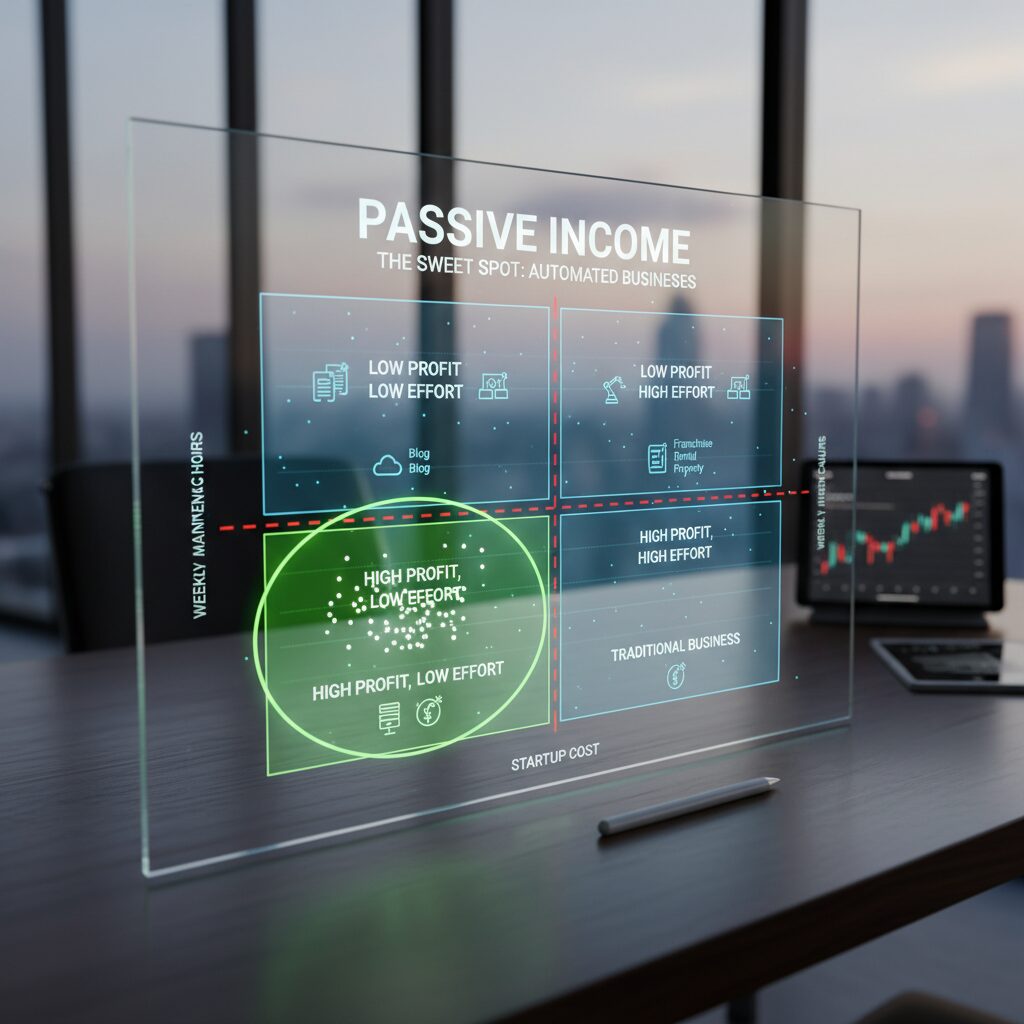
Tier 1: Digital “Zero-Touch” Businesses (High Margin)
Digital businesses have always offered the highest margins because the cost of replication is zero. However, the maintenance used to be high. Here is how AI has changed the equation.
1. Automated Print-on-Demand (Home Decor Focus)
Most people fail at Print-on-Demand (POD) because they try to sell t-shirts in a saturated market. The real money in 2025 is in Home Decor.
Source: Straits Research (May 2025 Report Update)
The Strategy: Instead of competing for apparel, you focus on high-ticket items like framed canvas art, rugs, and bedding. The automation comes from linking AI design tools directly to fulfillment centers.
🛠️ The Automation Stack
- Creation: Midjourney v6 (for generating high-res art patterns)
- Upscaling: Topaz Gigapixel (to ensure print quality at large sizes)
- Fulfillment: Printify (auto-routes orders to local print shops)
- Sales Channel: Etsy or Shopify (integrated via API)
Why it works: You never touch the product. When a customer buys a $120 canvas on your site, Printify automatically charges you $70, prints it, ships it, and you keep the $50 difference. Your only job is feeding the AI design prompts.
2. Micro-SaaS using No-Code Tools
You don’t need to be a developer to build software anymore. “Micro-SaaS” refers to small, dedicated software that solves one specific problem for a specific niche.
The market appetite is voracious. According to Gartner’s Nov 2024 forecast, global SaaS spending is projected to grow 19.4% in 2025 to reach $300 billion. The biggest drivers are tools that prioritize AI-driven automation.
The Concept: Build a tool that wraps around the OpenAI API. For example, a “Legal Contract Summarizer for Real Estate Agents.” You build the interface using a no-code builder, and the AI does the work.

3. Programmatic Affiliate SEO
Affiliate marketing is often pitched as “passive,” but writing reviews is exhausting. The automated solution is Programmatic SEO.
This involves building a database (e.g., “Best Hiking Boots for [City]”) and using a template to generate thousands of landing pages automatically. It captures long-tail search traffic that major competitors ignore.
Source: Influencer Marketing Hub / Ahrefs (Oct 2024)
Brands are desperate for this traffic. Impact.com’s Global State of Affiliate Marketing 2025 report notes that “74% of brands increased affiliate investment due to other channels becoming more expensive.” This creates a massive opportunity for automated traffic generators.
Tier 2: Physical “Tech-Enabled” Businesses (High Reliability)
If digital feels too intangible, physical automation offers security. However, we aren’t talking about old-school setups. We are looking at IoT (Internet of Things) enabled businesses.
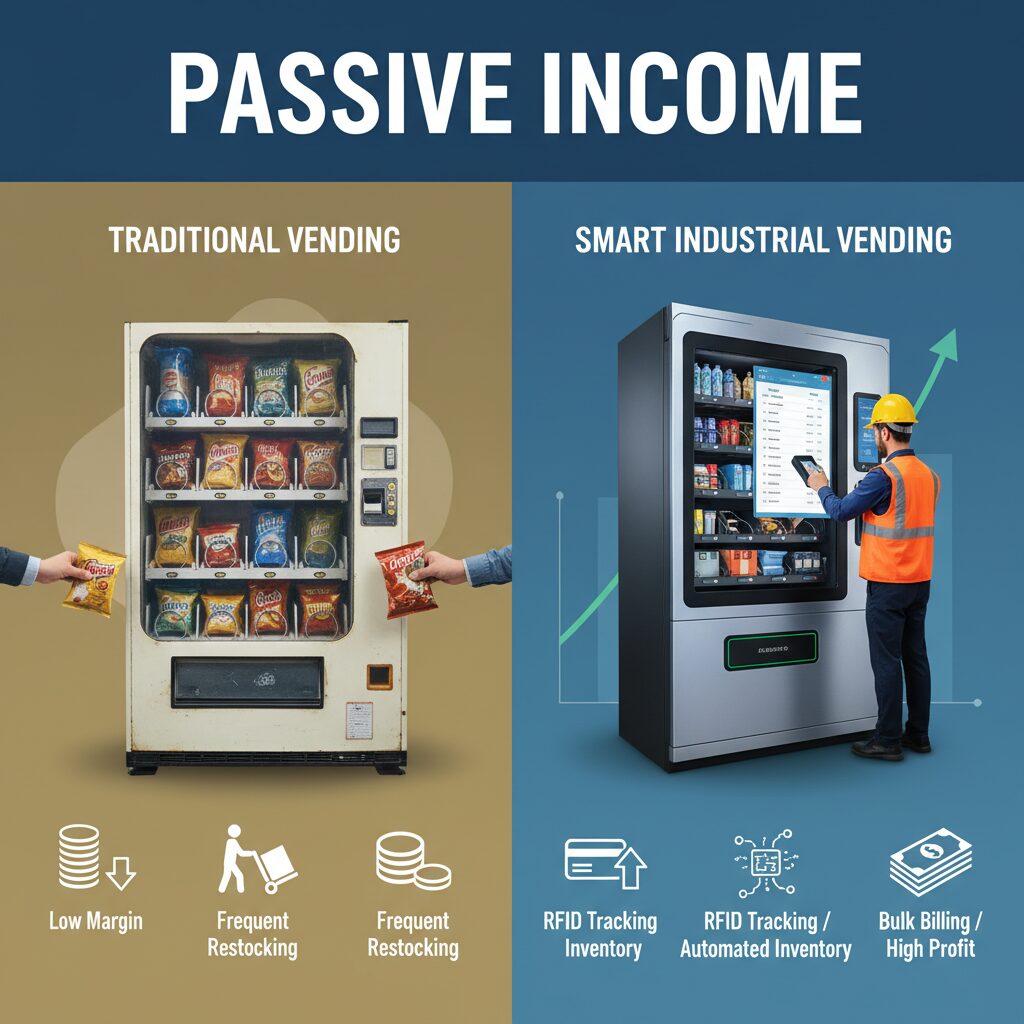
4. Industrial Smart Vending (B2B)
Forget selling Snickers bars. The real “low maintenance” money is in Industrial Vending. These are machines placed in factories that dispense gloves, safety goggles, and tools to employees.
The Math: In a traditional B2C vending route, you are chasing quarters. In B2B, the company pays you a monthly retainer or bulk bills for the inventory used. It’s cleaner, safer, and more consistent.
Source: Grand View Research (2024 Report)
Why it’s low maintenance: Modern machines have telemetry. You can check stock levels from your phone. You only visit the site when the machine tells you it’s 80% empty. No guessing.
5. Digital Laundromats
Laundromats are the classic “boring business,” but the 2025 version is unrecognizable. By utilizing remote locking systems and app-based payments, you can operate a laundromat without ever being on-site.
The Tech: Systems like Cents or SpyderWash allow you to restart machines, refund customers, and unlock doors remotely. Security cameras with two-way audio handle the “management.”
Tier 3: The Creator Economy Automation
The “Creator Economy” is often associated with burning out on camera. But automation allows you to be a creator without being a “personality.”
6. AI-Curated Newsletters
Newsletters are valuable assets. Goldman Sachs predicts the creator economy will roughly double to $480 billion by 2027. The smartest play is the curation model.
You don’t write the news; you curate it.
The Workflow:
1. An RSS feed collects top news in your niche (e.g., Solar Energy).
2. An AI agent (via Zapier) summarizes the top 5 stories.
3. You review the draft and hit send.
This transforms a 4-hour writing task into a 15-minute review task, allowing you to capture sponsorship revenue with minimal effort.
7. Faceless YouTube Channels (AI Video)
YouTube pays, but editing video is a grind. New tools like InVideo and ElevenLabs allow for “Faceless” channels where stock footage and AI voiceovers create the content.
While the quality bar is rising, the efficiency is undeniable. HubSpot’s State of Marketing Report 2024 found that “74% of marketers now use AI in their workflows, and 87% report increased efficiency.” If you aren’t using these tools, you are competing with one hand tied behind your back.
Critical Reality Check: Maintenance vs. Growth
I want to be transparent. “Low maintenance” refers to the running phase. The building phase is where the work happens. Here is a realistic breakdown of the time investment required.
| Business Model | Startup Cost | Setup Time (One-time) | Maintenance (Weekly) |
|---|---|---|---|
| Automated POD | Low ($100-$500) | 40+ Hours | 2-4 Hours |
| Micro-SaaS | Medium ($500-$2k) | 100+ Hours | 5-10 Hours |
| Industrial Vending | High ($5k-$10k) | 20 Hours | 2-3 Hours |
| AI Newsletter | Low ($50/mo) | 10 Hours | 1 Hour |
FAQ: Navigating Automated Business Models
What is the most profitable automated business?
Based on margin data, Micro-SaaS offers the highest potential margins (often 80%+), as software has almost zero reproduction costs. However, it requires the highest technical skill to set up. For physical businesses, Industrial Vending offers the highest stability and recurring revenue.
How can I start a passive business with no money?
Digital dropshipping (selling PDFs, Templates, or Data sets) requires $0 in inventory. You can use free tiers of tools like Notion to create the product, Canva to design the marketing, and social media for traffic. The only cost is your time.
Are vending machines actually low maintenance?
Only if you use “Smart Vending” with telemetry (remote stock monitoring). Traditional machines require 5-10 hours per week of driving and checking. With modern telemetry, you only drive when the machine tells you it needs service, cutting maintenance time by 60%.
What is “Agentic Commerce”?
Agentic Commerce is the 2025 trend where AI agents actively buy and sell products for humans. For business owners, this means using AI to handle customer support inquiries and process orders automatically, removing the human bottleneck from the sales process.
The Verdict: Pick Your Tech Stack
The dream of the “low maintenance” business is more achievable in 2025 than ever before, but only if you respect the data.
If you have capital but no time, look at Industrial Vending or Digital Laundromats. If you have time but no capital, look at Programmatic SEO or AI Newsletters.
As Shopify’s Future of Commerce report indicates, with mobile commerce sales projected to hit $2.07 trillion, the market is there. The only variable is how efficiently you can capture it.
Don’t just build a business. Build a system.
